
 tradeportx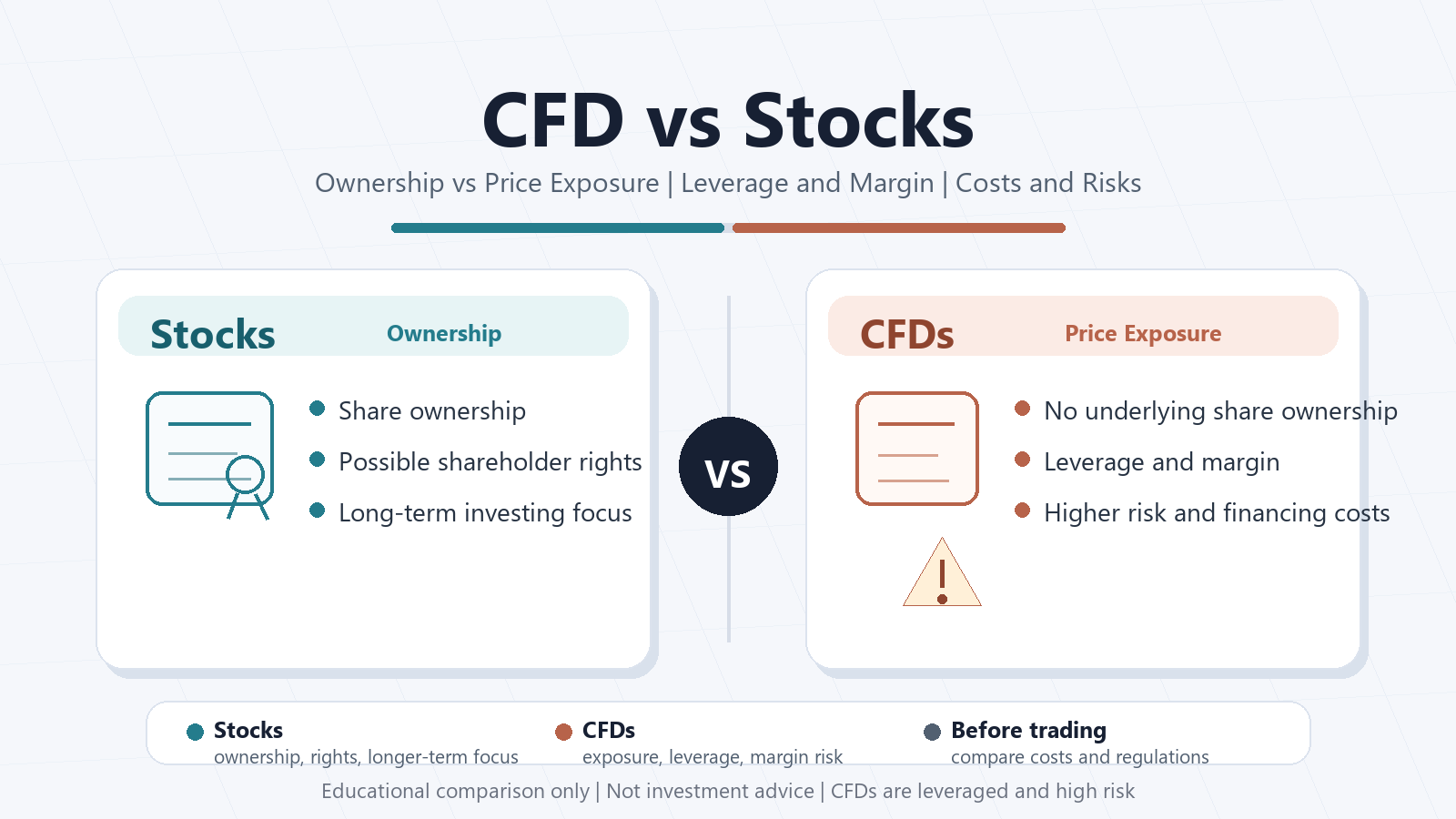
CFD vs stocks comes down to ownership and leverage. When you buy stocks, you usually own company shares and may receive shareholder rights such as voting rights or dividends. When you trade stock CFDs, you speculate on price movements without owning the underlying shares, often using margin and leverage. That can reduce the upfront capital required, but it can also magnify losses, trigger margin close-outs, and add costs such as spreads, commissions and overnight financing.
Risk warning: Contracts for Difference (CFDs) are complex, leveraged products and are not suitable for all retail investors. This article is for education only and does not provide investment advice, trading signals or a recommendation to trade CFDs or stocks.
When I first compared CFDs with stocks, I made the comparison too simple. I saw CFDs as a faster, leveraged version of stock trading. The more useful learning path was to slow down and ask what I actually owned, what exposure I was taking, what costs applied, and what could happen if the position moved against me.
CFD vs Stocks Quick Facts
| Question | Short Answer |
|---|---|
| What is the main difference between CFD and stock trading? | Stocks usually involve ownership of shares. CFDs provide price exposure through a derivative contract without owning the underlying shares. |
| Do you own stocks with CFDs? | No. A stock CFD gives exposure to price movements, not normal ownership of the underlying shares. |
| Why are CFDs considered higher risk? | CFDs commonly use leverage and margin, so losses can be magnified compared with the initial margin paid. |
| What costs should beginners compare? | Stock fees may include brokerage, exchange fees, custody, tax or FX costs. CFD costs may include spreads, commissions, overnight financing and conversion costs. |
| Is this guide for US CFD trading? | No. US readers should treat this as educational only because stock-based CFDs may fall under US security-based swap rules. |
What Is the Main Difference Between CFDs and Stocks?
The main difference between CFDs and stocks is ownership.
The mistake I would avoid as a beginner is thinking the two products only differ by leverage. Leverage is important, but ownership comes first. Once I understood that a stock CFD usually does not make me the shareholder, the rest of the comparison became clearer.
When you buy stocks, you usually buy shares in a company. That may give you shareholder rights, such as voting rights, dividends, corporate action participation or ownership-style exposure, depending on the market, broker and share class.
When you trade a Contract for Difference, or CFD, you enter into a derivative contract based on the price movement of an underlying asset. A stock CFD tracks the price movement of a stock, but it does not usually make you the owner of that stock.
That ownership difference affects almost everything else:
- how much capital you need upfront
- whether leverage is involved
- what rights you may or may not receive
- how costs are charged
- whether short exposure is easier to access
- how quickly losses can grow
- which regulations apply in your region
For a beginner, the simplest way to think about it is:
- Stocks are usually about owning shares.
- CFDs are usually about leveraged price exposure.
That does not mean stocks are risk-free. Stocks can fall sharply, and individual companies can lose value. But CFDs add extra layers of product risk because they commonly involve leverage, margin, financing costs and close-out rules.
Do You Own Stocks When You Trade CFDs?
No. With a stock CFD, you normally do not own the underlying company shares.
You are trading a contract with a provider. The profit or loss depends on the difference between the opening and closing price of the CFD position, after costs. If the underlying stock rises and you are long, the CFD position may gain value. If it falls, the position may lose value. The opposite applies to a short CFD position.
This is different from buying shares directly. A shareholder may have voting rights, dividend rights and other ownership-related rights. A CFD holder usually does not receive those normal shareholder rights. Some CFD providers may make cash adjustments for dividends or corporate actions, but those adjustments are contract terms, not the same as owning shares.
This is why the keyword difference between cfd and stock is important. The difference is not only a trading-style difference. It is a legal, economic and risk difference.
CFD vs Stocks: Quick Comparison
The table below gives a beginner-level view of cfd vs stocks. Specific costs and rules depend on the provider, market and jurisdiction.
| Dimension | Stocks | Stock CFDs |
|---|---|---|
| Ownership | Usually direct ownership of company shares | No ownership of the underlying shares |
| Product type | Security or share ownership | Derivative contract |
| Upfront capital | Usually the full position value in a cash account | Usually margin-based |
| Leverage | Usually no leverage in a simple cash account | Commonly leveraged |
| Shareholder rights | May include voting rights and dividends | No normal shareholder rights; possible contract adjustments |
| Direction | Usually simple long exposure for beginners | Often allows long and short exposure |
| Holding period | Can be used for long-term investing | Often used for shorter-term leveraged exposure |
| Common costs | Brokerage, exchange fees, custody, tax or FX costs depending on market | Spread, commission, overnight financing, conversion costs or platform fees |
| Main risk | Market risk and company-specific risk | Market risk plus leverage, margin, close-out, financing and provider risk |
| Beginner suitability | Easier to understand for ownership-focused investors | Higher complexity; requires margin and leverage understanding |
The table is not a recommendation. It is a framework for understanding how the products differ before deciding what to learn next.
The way I would use this table is not to pick a winner immediately. I would first mark which column matches my actual goal. If the goal is ownership, dividends or long-term portfolio building, the stock column is usually easier to understand. If the goal is short-term leveraged exposure, the CFD column needs much more risk checking before it can be considered. If you are still deciding whether CFDs are worth learning at all, see is CFD trading worth it.
CFD vs Stocks: How Leverage and Margin Change the Risk
Leverage is one of the biggest reasons CFDs are riskier for many beginners.
With a traditional cash stock purchase, you usually pay the full value of the shares you buy. If you buy $1,000 of shares, the exposure is $1,000 and you normally pay the full $1,000, plus any fees.
The Margin Number Is Not the Exposure
With a CFD, you may only need to deposit a margin amount to open a larger position. For example, if a provider requires 20% margin on a stock CFD, a $1,000 exposure may require $200 of initial margin. That lower upfront amount can make the position look more accessible, but the profit and loss are still based on the full $1,000 exposure.
This is the key beginner mistake: margin is not the maximum possible loss in all situations. It is the amount required to open or maintain the position. If the market moves against the position, losses can grow quickly, and the provider may ask for more margin or close the position.
The question I would ask myself is: can I explain the full exposure without looking only at the margin number? If I cannot do that, I would not treat a CFD as a simple alternative to buying the stock.
Regulators have restricted retail CFD leverage because of this risk. The UK Financial Conduct Authority (FCA) applies retail CFD restrictions that include leverage limits, margin close-out rules, negative balance protection and standardized risk warnings. The Australian Securities and Investments Commission (ASIC) also applies retail CFD leverage restrictions under its product intervention order. The European Securities and Markets Authority (ESMA) introduced similar retail CFD measures in 2018.
For beginners, the practical lesson is simple: CFDs should not be understood only by asking “How much money do I need to open the trade?” You also need to ask:
- What is the full exposure?
- What margin is required?
- What happens if the position moves against me?
- When can the provider close the position?
- What overnight costs apply?
- Could I lose money quickly even if the initial margin looks small?
CFD vs Stocks Costs: Spread, Commission, Overnight Fees and Stock Trading Costs
Neither CFDs nor stocks are automatically cheaper in every situation. The cost depends on the market, provider, trade size, holding period and account type.
Stock trading costs may include:
- brokerage commission
- exchange or clearing fees
- custody fees
- stamp duty or local taxes in some markets
- foreign exchange conversion costs
- platform or account fees
CFD trading costs may include:
- bid-ask spread
- commission, especially on share CFDs
- overnight financing
- currency conversion
- platform fees
- data or market access fees
- potential guaranteed stop or risk-management feature costs, depending on provider terms
The holding period matters. A stock investor who holds shares for months or years may focus on brokerage, custody and tax treatment. A CFD trader who holds positions overnight may need to consider financing costs every day the position stays open.
This is why a beginner guide should not say “CFDs are cheaper” or “stocks are always cheaper.” The better question is:
What is the total cost for this product, on this platform, in this market, for this holding period?
Before trading, compare the provider’s product specifications and fee schedule. If the article is later adapted for a specific platform, the platform’s share CFD contract specifications and fees page should be added as direct sources.
If your next question is whether a small account can even start, see CFD minimum deposit for a separate explanation of $100, margin, minimum trade size and risk buffer.
CFD vs Stocks: Can You Go Short?
CFDs are often marketed as a way to trade both rising and falling markets. A long CFD position benefits if the underlying price rises. A short CFD position benefits if the underlying price falls.
That is different from simple cash stock trading, where beginners usually buy shares and profit only if the share price rises. Traditional stock short selling can exist, but it often involves borrowing shares, margin requirements, local market rules and additional restrictions.
Short CFD trading can look simpler because the provider may offer short exposure directly through the CFD platform. But the risk is still serious. A short position loses money when the underlying price rises. In fast-moving markets, losses can grow quickly, especially when leverage is used.
The beginner takeaway is not that short CFD trading is better. It is that CFDs can make short exposure more accessible, but also more complex and risky.
CFD vs Share Trading by Region: UK, Australia, Singapore and US
Because this article targets International English readers, region matters. The phrase cfd vs share trading is especially common in UK, Australia and Singapore contexts, while US readers often use stocks rather than shares.
| Region | How to Understand CFDs | Important Compliance Note |
|---|---|---|
| UK | CFDs are available through regulated providers but treated as high-risk retail products | FCA rules include leverage limits, margin close-out, negative balance protection, incentive restrictions and risk warnings |
| Australia | Retail CFDs are available under product intervention conditions | ASIC restricts retail CFD leverage by asset class and requires customer protections |
| Singapore | CFDs are available but treated as complex Specified Investment Products | MoneySense explains that customers may need a Customer Knowledge Assessment before opening a CFD account |
| US | Do not treat this article as a US CFD trading guide | Stock-based CFDs offered to US retail investors may fall under the US security-based swap framework |
For US readers, the important point is caution. Stock-based CFDs should not be treated as normal retail stock products. The SEC has brought actions involving stock-based CFDs offered to US retail investors as security-based swaps without the required registration or exchange trading framework. This article is educational and does not describe a US CFD trading offer.
For UK, Australia and Singapore readers, CFDs may be available through regulated providers, but availability does not mean suitability. The product can still be high risk, especially for beginners who do not fully understand leverage, margin and costs.
CFD vs Stocks: Which Is Riskier for Beginners?
For most beginners, CFDs are usually riskier than direct stock ownership because CFDs add leverage and margin mechanics on top of normal market risk.
A stock can fall in price, and a shareholder can lose money. That risk is real. But if the investor buys shares in a cash account, the position is usually easier to understand: the investor owns shares, the share price moves, and the account value rises or falls.
A stock CFD adds extra moving parts:
- margin requirements
- leveraged exposure
- close-out rules
- financing costs
- provider pricing
- possible short exposure
- regional product restrictions
This is why a beginner should not start with the question, “Which product can make more money?” A better beginner question is:
Which product do I actually understand well enough to manage the risk?
If a user cannot explain margin, leverage, overnight financing and close-out rules in plain language, they should not treat CFDs as a simple alternative to buying stocks.
CFD vs Stocks: When Might Stocks Be Simpler?
Stocks may be simpler when the goal is direct ownership.
A beginner who wants to understand companies, hold shares for the long term, receive potential dividends or build a portfolio may find direct stocks easier to understand than CFDs. Stocks still require research and risk management, but the ownership structure is usually more straightforward.
CFDs may be relevant only for users who understand leveraged derivative products and have a clear reason to use short-term price exposure rather than ownership. Examples might include users who understand margin, can tolerate rapid losses, and know how financing costs affect overnight positions.
That does not make one product universally better. It means the products solve different problems:
- Stocks are often used for ownership and investing.
- CFDs are often used for leveraged trading exposure.
For a beginner, the safer learning path is usually:
- Understand what stocks are.
- Understand what CFDs are.
- Compare ownership, costs and risk.
- Learn margin and leverage before opening any CFD position.
- Use a demo environment before considering live leveraged trading.
CFD vs Stocks: Common Beginner Mistakes
Many beginners misunderstand CFDs because the trading interface can make the product look simple. The risk is in the contract structure, not only in the buttons on the platform.
Common mistakes include:
- thinking a stock CFD means owning the stock
- focusing only on the initial margin, not the full exposure
- ignoring overnight financing
- assuming CFDs are always cheaper than stocks
- treating leverage as a benefit without understanding losses
- using short positions without understanding price gaps
- ignoring regional restrictions
- treating educational examples as trading advice
A good CFD vs stocks comparison should slow the user down. The goal is not to push a fast trading decision. The goal is to make the difference clear enough that the user knows what to research next.
How I Would Use This Comparison as a Beginner
If I were using this comparison as a beginner, I would not start with “Which one makes more money?” That question pushes the decision too far ahead. I would start with the product structure.
My first question would be whether I want ownership or price exposure. My second question would be whether I can explain margin, financing and close-out rules in plain language. My third question would be whether I have checked the exact costs for the product, platform and region.
If I could not answer those questions, I would keep the comparison in learning mode. I might read more, use a demo environment or compare costs, but I would not treat the table as a reason to open a live leveraged position.
FAQ
Do you own stocks with CFDs?
No. With a stock CFD, you get exposure to the price movement of the underlying shares, but you do not normally own the shares or receive standard shareholder rights.
Are CFDs riskier than stocks?
For most beginners, yes. CFDs add leverage, margin calls, possible close-outs, overnight financing and provider risk on top of normal market risk. Stocks can still lose money, but direct stock ownership is usually easier to understand.
What is the difference between CFD and stock trading?
Stock trading usually means buying and owning shares. CFD trading means entering a derivative contract to speculate on price changes without owning the underlying asset.
Is CFD trading better than stock trading?
Not automatically. CFD trading may suit experienced users who understand leveraged short-term exposure, while direct stock trading may be simpler for users focused on ownership and long-term investing.
Is cfd vs share trading the same as cfd vs stocks?
Usually, yes. In UK, Australia and Singapore contexts, people often say shares or share trading. In US contexts, people more often say stocks. The core comparison is still ownership versus CFD price exposure.
Can US residents trade CFDs?
US readers should be cautious. Stock-based CFDs may fall under the US security-based swap framework, and this article should not be treated as a US CFD trading offer.
Do CFDs pay dividends?
CFD providers may apply dividend adjustments depending on the contract terms, but that is not the same as owning shares and receiving shareholder rights. Always check the provider’s product terms.
Are CFDs good for long-term investing?
CFDs are usually not designed for simple long-term ownership. Overnight financing and leverage can make long holding periods costly and risky. Long-term investors often compare direct stocks or ETFs instead.
Risk Warning and Next Step
CFDs are complex, leveraged products and can result in rapid losses. They may involve margin calls, close-outs, overnight financing and costs that beginners may underestimate. This guide is educational and does not recommend trading CFDs, buying stocks or choosing any specific platform.
If you are comparing CFD vs stocks, the next step is not to place a trade. The next step is to understand:
- how CFD leverage works
- how margin and close-outs work
- what costs apply to your region and platform
- whether the product is available and appropriate in your jurisdiction
- whether direct stock ownership is simpler for your objective
For more background on CFD vs stocks, future guides can cover CFD basics, leverage, trading costs and whether CFDs are riskier than stocks.
Sources
- FCA: Contract for differences
- FCA: PS19/18 Restricting contract for difference products
- ASIC: CFD product intervention order takes effect
- ESMA: Measures to restrict CFDs for retail investors
- MoneySense: Understanding contracts for difference
- SEC: Netrios LP Ltd. and Red Acre, Ltd.
- SEC: Security-Based Swap Markets
- CMC Markets: CFD vs share trading
- IG: CFD trading vs investing
- XTB: Real shares vs share CFDs
https://shorturl.fm/Q82r3