
 tradeportx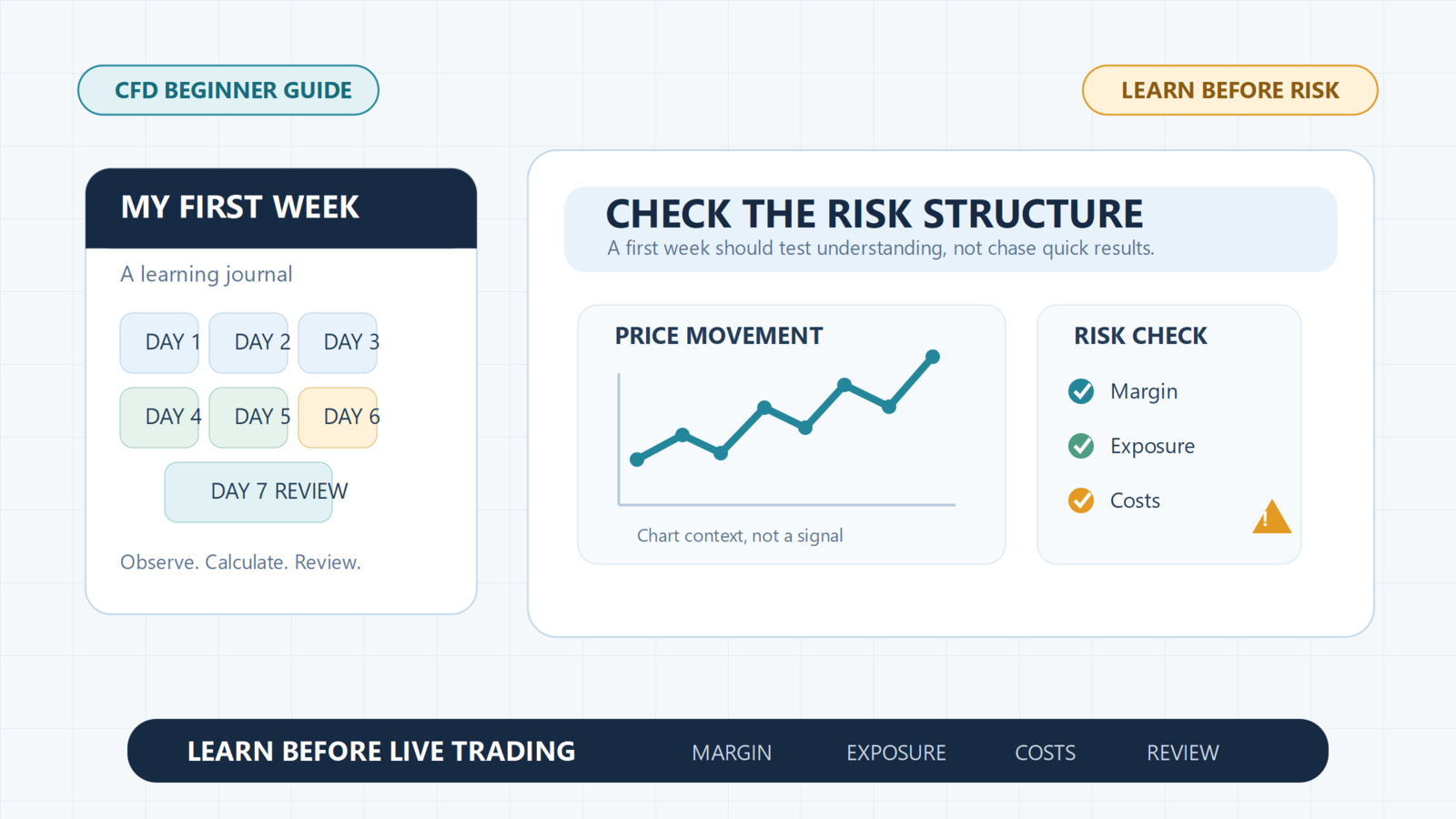
Focus Keyphrase: my first week trading CFDs
Last updated: August 20, 2026
Target market: Global English / worldwide English-speaking audience, with regional notes for the UK, Australia, Singapore and the US
My first week trading CFDs was not really a story about making money. It was a story about discovering how many things I did not understand before I opened a position. I started with a demo account and treated the week as a structured product-learning exercise: learning the platform, calculating exposure, checking costs, and observing how quickly a small price move could affect a leveraged position.
Risk warning: Contracts for Difference (CFDs) are complex, leveraged products and are not suitable for all retail investors. This article is educational only. It does not provide investment advice, trading signals or a recommendation to trade CFDs.
Quick Facts
| Question | Short Answer |
|---|---|
| What was the goal of my first week? | To understand the product and my process, not to prove I could make a profit. |
| Did I use real money? | I treated the first week as demo-based practice rather than a recommendation to fund a live account. |
| What surprised me most? | A small margin requirement can represent a much larger market exposure. |
| What costs did I watch? | Spread, commission where applicable, overnight financing, conversion costs and slippage. |
| What was my biggest lesson? | A platform can make CFD trading look simple while the risk structure remains complex. |
| Should beginners copy my approach? | No. Use it as a learning checklist, and check local rules and provider terms first. |
What I Expected Before My First Week Trading CFDs
Before studying CFDs seriously, I thought the difficult part would be choosing a market and deciding whether the price would rise or fall. The interface seemed straightforward: choose an instrument, select a position size, and click buy or sell.
That view was incomplete.
A CFD is a derivative contract based on the price movement of an underlying asset. I normally do not own the underlying share, index, currency pair or commodity. Instead, the result comes from the difference between the opening and closing prices, adjusted for the provider’s costs and terms.
The first question I needed to answer was not “Will the market go up?” It was:
What exactly am I exposed to, how much could that exposure cost, and what can happen if the market moves quickly against me?
That question shaped the rest of my week.
Day 1: I Learned the Platform Before Placing a Trade
On the first day, I focused on the mechanics of the account. I checked how the platform displayed:
- account balance and available funds
- required margin and used margin
- position size and full notional exposure
- spread and any commission
- stop-loss and take-profit settings
- margin level and close-out information
- overnight financing details
The platform made these fields look like ordinary settings. They were not ordinary settings. Each one could change the outcome of a trade.
I also compared the quote screen with the order ticket. The buy price and sell price were not identical. That difference is the spread, and it means a position can start with a small loss even before the market moves in the trader’s preferred direction.
My first practical lesson was simple: I should never open a CFD position until I can explain every number shown on the order ticket.
Day 2: Margin Was Not the Same as Risk
The second day changed how I thought about small accounts. The platform might show a relatively small margin requirement, but the position can still represent a much larger exposure.
A simplified example looks like this:
\text{Notional Exposure} = \text{Position Size} \times \text{Underlying Price}
The margin is collateral required to open or maintain the position. It is not a maximum-loss figure and it is not a safety cushion. If leverage is involved, a small amount of account capital can control a larger position, which means a small market move can produce a relatively large percentage change in account equity.
I wrote down three separate numbers for every practice position:
- the amount of margin required
- the full market exposure
- the amount I could lose before my planned exit or the provider’s close-out process became relevant
This stopped me from treating the margin figure as if it were the entire trade.
Day 3: I Added Costs Before Looking at Results
On the third day, I reviewed costs. My first instinct had been to look at whether a position was profitable. I changed the order: first identify costs, then examine the price result.
The costs I would check before any future trade include:
- the spread between buy and sell prices
- commissions, if the product charges them
- overnight or holding financing
- currency conversion charges
- guaranteed-stop or other optional feature fees
- slippage and execution conditions
A position can move in the expected direction and still produce a disappointing result if the price movement is small compared with the spread and other charges. Holding the position overnight can change the calculation again because financing may apply.
This was also where I stopped using the phrase “cheap trade.” A low minimum deposit or low visible commission does not describe the total cost of a CFD position.
Day 4: I Watched What Happened During Volatility
The fourth day was about observation rather than activity. I watched a demo position through a period of faster price movement and focused on the account metrics rather than the headline chart.
The main things I observed were:
- available margin changed as the position moved
- a stop-loss is an instruction, not a guarantee of an exact exit price in every market condition
- fast markets can make execution and slippage more important
- a position that looks small on the screen can still create uncomfortable account swings
- a close-out process is a risk-control mechanism, not a rescue plan
This was the day I understood why “I will just close it if it goes wrong” is not a complete risk plan. The trader still needs to know whether the platform can execute as expected, what the market is doing, and what happens if the account reaches a provider’s margin threshold.
Day 5: I Compared CFDs With Owning Stocks
By the fifth day, I compared the CFD structure with direct stock ownership. The comparison helped me identify the goal behind a trade.
| Feature | Stock Ownership | Stock CFD |
|---|---|---|
| What you generally hold | Shares in the company | A derivative contract linked to price movement |
| Ownership rights | May include voting or dividend rights, subject to the share and broker | Usually no ordinary ownership rights in the underlying shares |
| Leverage | Not inherent in an ordinary cash purchase | Commonly available, subject to product and jurisdiction |
| Short exposure | Usually requires a separate borrowing or short-selling arrangement | Often available through the contract structure, subject to terms |
| Holding costs | Depends on the account and asset | May include spread, commission and overnight financing |
| Main beginner question | Do I want to own the asset? | Do I understand leveraged price exposure and contract costs? |
The point was not to decide that one product is always better. It was to avoid using a CFD for an objective that actually required ownership, such as holding shares for the long term or receiving ordinary shareholder rights.
This connected with what I had learned in CFD vs stocks. The product choice should follow the objective, not the excitement of the interface.
Day 6: I Tested My Own Rules
On the sixth day, I stopped testing the market and tested my process. Before entering a practice position, I wrote down:
- why I was considering the position
- the full exposure rather than only the margin
- the maximum loss I was prepared to accept in the exercise
- the costs that could apply
- whether the position would be held overnight
- the condition that would make me exit
- what would make me avoid the trade completely
The most useful rule was also the least exciting: if I could not explain the position in one paragraph, I did not open it.
I also checked whether I was changing the position size after a losing trade. That behaviour can turn a learning exercise into an attempt to recover losses. A demo account can hide this emotional pattern because there is no real financial consequence, but it can still reveal poor decision habits.
Day 7: I Reviewed the Week Instead of Counting Wins
At the end of the week, I reviewed decisions rather than profits. My notes included:
- Did I understand the contract?
- Did I calculate full exposure?
- Did I identify all visible and possible costs?
- Did I know the provider’s margin and close-out terms?
- Did I follow the plan after the market moved?
- Did I open a position because of a reason or because I was bored?
- Did I confuse a demo result with evidence that I was ready for live trading?
The review showed me that a “successful” first week cannot be measured only by the account balance. A profitable demo week can happen by chance. A losing demo week can reveal a useful mistake. The more meaningful result is whether the process became clearer and more controlled.
What My First Week Trading CFDs Taught Me
1. The interface is simpler than the product
A platform may reduce a complicated derivative to a few buttons. That improves usability, but it does not remove leverage, margin, costs or close-out risk.
2. A small account has less room for error
A small account is not automatically safer. A limited balance can make spreads, financing, slippage and normal market movement more significant relative to the account.
3. Demo trading has a narrow purpose
A demo account can help with platform mechanics and process testing. It cannot reproduce every part of live trading, including emotional pressure, execution conditions and the consequences of losing real money.
4. Regulation changes the practical answer
CFD availability, leverage limits, marketing rules and retail protections differ by jurisdiction. A platform being visible online does not mean the product is available or suitable where I live.
5. Learning is not the same as readiness
I can learn how CFDs work without deciding that live CFD trading is appropriate for me. That distinction is especially important for beginners.
My First Week CFD Checklist
Before considering a live account, I would want clear answers to these questions:
- What is the underlying asset and what does the contract track?
- Do I own the underlying asset? Usually, no.
- What is the full notional exposure?
- How much margin is required?
- What costs apply when opening, holding and closing?
- Could overnight financing apply?
- What are the provider’s margin-call and close-out rules?
- How could slippage affect the exit?
- Is the product available to retail clients in my jurisdiction?
- Am I using a CFD for an objective that would be better served by owning the asset directly?
If I cannot answer these questions, I would continue studying rather than fund a live account.
Region Notes: UK, Australia, Singapore and the US
Rules and product availability are local. The FCA, ASIC and Singapore’s MoneySense materials all emphasise that CFDs are complex and leveraged products, but the exact protections and provider obligations differ.
| Region | What Beginners Should Check |
|---|---|
| United Kingdom | FCA retail CFD restrictions, leverage limits, margin close-out and negative-balance protections where applicable |
| Australia | ASIC retail CFD product intervention rules, leverage limits and provider disclosure |
| Singapore | Whether the provider is authorised and what product knowledge, margin and risk disclosures apply |
| United States | Do not treat this as a US CFD trading guide; stock-based CFDs may involve the security-based swap framework |
For current requirements, check the relevant regulator and the provider’s legal terms before acting.
Is My First Week Trading CFDs a Reason to Continue?
My answer is: it was a reason to keep learning, not a reason to increase risk.
The week helped me understand the product’s structure, but it did not prove that I could predict markets or manage live losses. If I wanted simple long-term ownership, I would compare direct stocks or diversified funds instead. If I wanted to continue learning CFDs, I would focus on exposure, costs, margin and risk controls before considering any live decision.
That is why my first-week conclusion is deliberately cautious:
The first week should answer whether you understand the product—not whether you can make a quick profit.
FAQ
What should I do during my first week trading CFDs?
Use the week to learn the platform, contract specifications, exposure, margin, costs, close-out rules and local availability. Do not treat a first-week result as proof of skill.
Should my first week trading CFDs use real money?
A beginner should not rush into live trading. Demo practice can help with mechanics, but it does not remove the risks of real-money trading.
What is the biggest lesson from a first week of CFD trading?
Margin is not the same as risk. A small margin requirement can represent a much larger exposure, and losses can be affected by leverage, costs and market movement.
Can I make money in my first week trading CFDs?
A trader may make or lose money, but a one-week result is not a reliable measure of skill. Short-term results can be dominated by market conditions and chance.
Is CFD trading suitable for beginners?
CFDs are complex and leveraged. Beginners may study them, but should not assume that understanding the buttons means understanding the risks or suitability.
How do CFDs differ from stocks?
Buying stocks usually creates ownership of shares. A stock CFD normally creates price exposure through a derivative contract without ordinary ownership rights.
What costs should I check before opening a CFD?
Check the spread, commission, overnight financing, conversion charges, slippage conditions and any provider-specific fees.
Is a demo account enough before live CFD trading?
No. A demo account can test mechanics and discipline, but it cannot fully reproduce emotional pressure, execution conditions or real financial loss.
Risk Warning and Next Step
CFDs are complex, leveraged products. They can involve rapid losses, margin calls, close-outs, overnight financing, spreads, commissions, slippage and provider-specific terms. This article is educational and does not recommend trading CFDs, selecting a broker or taking any market position.
A sensible next step is to read What Is CFD Trading and What I Wish I Knew Before Trading CFDs, then write down the contract, exposure, margin, costs and close-out rules for one demo product. If any part is unclear, keep learning before using real money.