
 tradeportx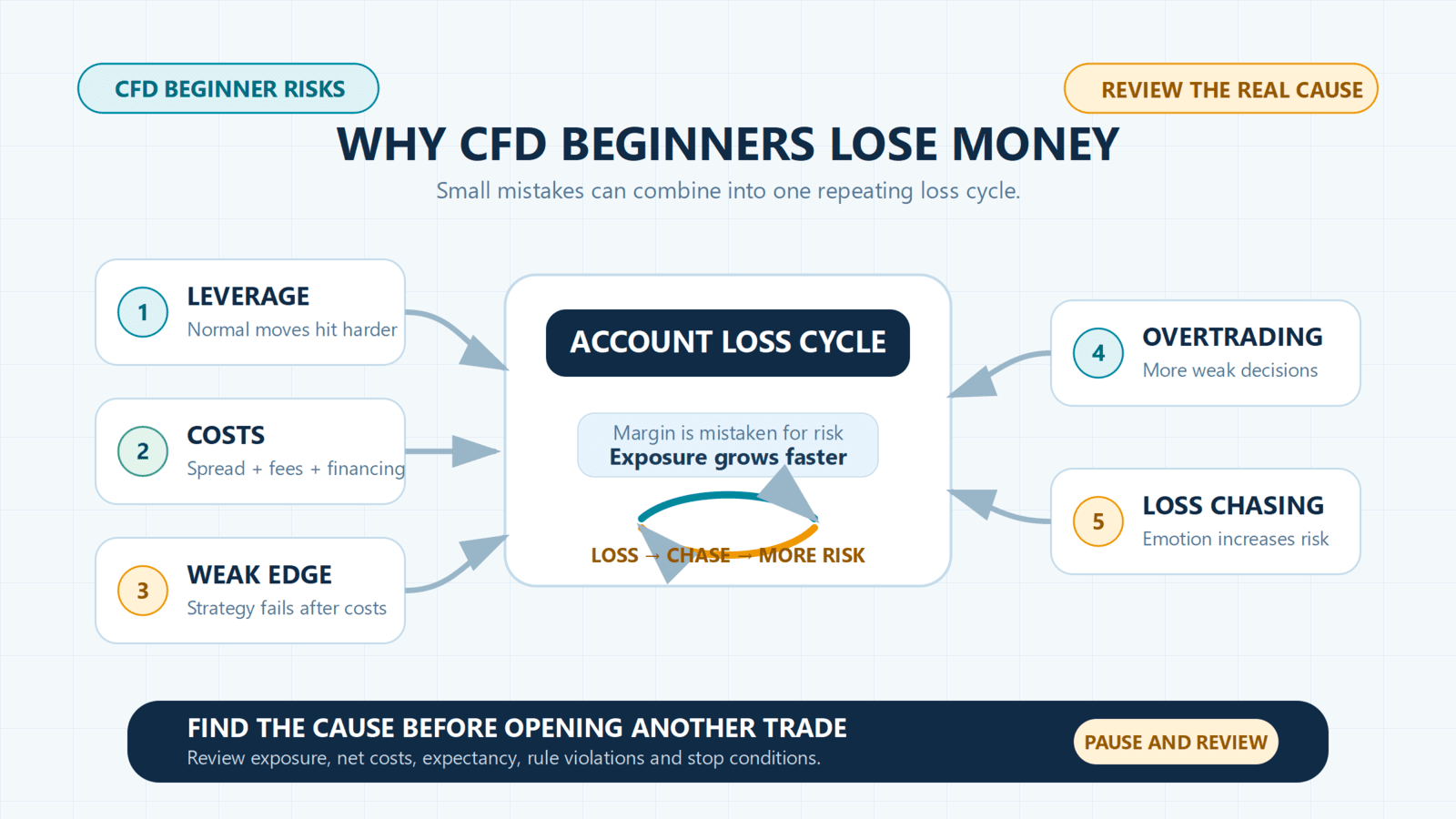
Focus Keyphrase: CFD beginners lose money
Last updated: August 31, 2026
Target market: Global English / worldwide English-speaking audience, with region-specific notes for the UK, Australia, Singapore and the US
Why do so many CFD beginners lose money? The main reasons are not simply that markets are unpredictable. Beginners often combine leverage, incomplete product knowledge, trading costs, small accounts, untested strategies and emotional decisions. Each problem may look manageable by itself, but together they can deplete an account quickly.
Regulators report losses across the wider retail CFD market, not only among beginners. ASIC reported that 68% of Australian retail CFD investors lost money in the 2024 financial year. Earlier ESMA analysis found that 74% to 89% of retail CFD accounts typically lost money across the EU. Those figures do not prove that every beginner will lose, but they show that losses are structural and widespread rather than unusual exceptions.
Risk warning: Contracts for Difference (CFDs) are complex, leveraged products and can result in rapid losses. This article is educational only. It does not provide investment advice, trading signals, a profitable strategy or a recommendation to trade CFDs.
Quick Facts
| Question | Short Answer |
|---|---|
| Why do CFD beginners lose money? | Leverage, costs, poor position sizing, untested methods and emotional decisions often combine. |
| Do most retail CFD traders lose? | Regulators repeatedly report that a majority of retail CFD accounts or investors lose money. |
| Is leverage the only reason? | No. Leverage accelerates the result, but strategy quality, costs, execution and behaviour also matter. |
| Can a good win rate still lose money? | Yes. Average losses, average wins and costs matter more than win rate alone. |
| Does a stop-loss guarantee a small loss? | No. Gaps and slippage can produce a worse execution price. |
| Can risk management make CFDs profitable? | It can limit damage, but it cannot create an edge or guarantee profits. |
A Necessary Data Warning Before Explaining Why CFD Beginners Lose Money
The title refers to beginners, but regulator statistics usually describe all retail CFD clients or accounts. They do not always separate first-time traders from experienced retail traders.
I would therefore avoid saying that a specific percentage of beginners lose. The more accurate conclusion is:
- a majority of retail CFD clients lose money in the official data available
- beginners face additional learning errors because leverage, margin, costs and execution are unfamiliar
- a regulated platform does not remove those errors
- a short profitable period does not prove that the beginner has overcome them
The purpose of this article is not to predict an individual’s result. It is to explain the mechanisms that repeatedly turn small mistakes into account losses.
Reason 1: Beginners Focus on Margin Instead of Full Exposure
The order ticket may show a relatively small margin requirement. That number can feel like the amount being risked, but margin is collateral for a larger position.
A simplified relationship is:
\text{Notional Exposure} = \frac{\text{Initial Margin}}{\text{Margin Rate}}
If $200 of margin supports $4,000 of exposure, price changes affect the $4,000 position—not only the $200 margin figure.
This is often the first major misunderstanding. A beginner may believe the position is small because the cash required to open it is small. The trade can therefore be oversized before the market has moved at all.
Can you lose more than you invest in CFDs? explains why initial margin is not a maximum-loss limit.
Reason 2: Leverage Makes Normal Market Movement Feel Abnormal
Leverage magnifies the account impact of ordinary price movement. A market does not need to crash for a highly leveraged account to experience a large percentage loss.
Beginners may respond to that movement in two damaging ways:
- close a planned trade early because the account fluctuation feels too large
- hold an invalid trade because accepting the leveraged loss feels too painful
In both cases, the position size—not only the market analysis—creates the problem.
A position should be sized around a predefined account loss and realistic exit conditions. Using the maximum margin available reverses that process: the platform decides the exposure first, and the trader tries to manage the risk afterward.
Reason 3: CFD Beginners Lose Money Through Costs Before Their Strategy Is Tested
A CFD trade can involve:
- spread
- commission
- overnight financing
- currency conversion
- slippage
- guaranteed-stop or other optional charges
These costs create a hurdle before a strategy produces a net profit. Frequent trading increases the number of times the trader pays that hurdle.
Suppose a method has an average gross win of $55 and an average gross loss of $50. If average transaction and holding costs reduce each winning trade by $8 and increase the effective losing result by $4, the original advantage may disappear.
This is why screenshots of profitable trades are incomplete. A useful performance record must show net results after every cost.
Reason 4: The Strategy Has Not Demonstrated an Edge
A beginner may call any repeatable entry rule a strategy. But repeatability is not the same as positive expectancy.
A simplified expectancy formula is:
\text{Expectancy} = (P_w \times A_w) – (P_l \times A_l) – C
where:
- P_w is the probability of a win
- A_w is the average winning amount
- P_l is the probability of a loss
- A_l is the average losing amount
- C is the average cost per trade
If expectancy is negative after costs, disciplined repetition can still produce disciplined losses.
A few demo wins or one profitable week are not enough to estimate these values reliably. Market conditions can temporarily favour an approach, and a small sample can make luck look like skill.
Reason 5: Beginners Confuse Win Rate With Profitability
A high win rate feels reassuring, but it can hide an unfavourable payoff structure.
Consider two simplified traders:
| Trader | Win Rate | Average Win | Average Loss | Result Before Costs |
|---|---|---|---|---|
| Trader A | 70% | $20 | $60 | Negative expectancy |
| Trader B | 40% | $60 | $25 | Positive expectancy |
Trader A wins more often but loses much more when wrong. Trader B loses more often but keeps losses smaller relative to wins.
Beginners may create Trader A’s pattern by taking profit quickly and allowing losing positions more time to recover. The account receives frequent small positive feedback while a few large losses erase the gains.
Reason 6: Overtrading Multiplies Weak Decisions and Costs
Overtrading means opening more positions than the plan or evidence justifies. Common triggers include:
- boredom
- fear of missing out
- trying to recover a previous loss
- reacting to every small chart movement
- platform notifications
- confidence after a winning streak
More trades do not automatically create more opportunities. They create more exposure to costs and more chances to abandon the process.
The FCA has warned that gaming-style features in trading apps can increase trading frequency and risk-taking. Easy order entry is useful, but speed can remove the pause in which a beginner would otherwise reconsider the trade.
Reason 7: Loss Chasing Changes the Goal
After a losing trade, the original goal should still be to follow a tested process. Loss chasing changes the goal to recovering money as quickly as possible.
The trader may:
- double the next position
- enter without a valid setup
- remove or widen the stop-loss
- deposit more money under pressure
- trade a more volatile product
At that point, the next position is being sized by emotion rather than evidence.
This connects with Is CFD trading gambling?. CFD trading is a financial activity where regulated, but loss chasing and leverage escalation can make the behaviour gambling-like.
Reason 8: Small Accounts Have Less Room for Error
A small account is not automatically safer. The same minimum trade size, spread or overnight charge represents a larger percentage of a small balance.
A beginner with a small account may also feel pressure to use leverage because an unleveraged result appears too small. This creates a contradiction:
- the account has the least capacity to absorb losses
- the trader feels the greatest temptation to increase exposure
Can you trade CFDs with $100? explains why technical platform access is not the same as having a suitable risk buffer.
Reason 9: Stops, Gaps and Close-Outs Are Misunderstood
A stop-loss is an instruction to close a position when a level is reached. A normal stop-loss does not necessarily guarantee that exact execution price.
During a market gap or fast movement:
- the market may skip over the stop level
- the order may execute at the next available price
- the realised loss may be larger than planned
- the account’s margin level may deteriorate quickly
- the provider may close other positions under its close-out rules
Beginners may also assume that the provider’s margin close-out process is a personal risk-management plan. It is not. Close-out is an account protection mechanism with provider and regulatory rules; it does not guarantee preservation of a chosen balance.
Reason 10: There Is No Review Process or Stop Condition
Without a journal, a beginner remembers dramatic wins and losses but may miss the repeated cause of the account decline.
A useful review should track:
- reason for entry
- full exposure
- planned and realised loss
- spread, commission and financing
- whether the rules were followed
- market conditions
- emotional state
- screenshots before and after the trade
- cumulative results by setup, not only total balance
The trader also needs a stop condition. Examples include stopping after a predefined account drawdown, repeated rule violations or evidence that the method has negative expectancy.
A stop condition is not a prediction that the next trade will lose. It is a rule that prevents uncertainty from turning into unlimited experimentation with real money.
Why Risk Management Does Not Solve Everything
Risk management is necessary because it limits damage. It is not sufficient because it does not make a weak strategy profitable.
A trader can follow a 1% account-risk rule and still lose gradually if:
- entries have no edge
- costs are underestimated
- average wins are too small
- correlated positions create hidden concentration
- rules change after every few trades
The role of risk management is survival and consistency. The role of strategy testing is to determine whether there may be a positive expectation. Both are required, and neither guarantees future results.
The Beginner Loss Cycle
Many account losses follow a repeating sequence:
- A low margin requirement makes the product look accessible.
- The beginner opens a position larger than intended.
- Normal movement creates an uncomfortable account loss.
- The trader closes early, moves the stop or waits without a rule.
- Costs reduce the result further.
- The trader opens another position to recover.
- Position size increases while decision quality falls.
- A large loss or close-out ends the cycle.
The cycle can happen even when several positions are profitable. Frequent small wins may delay recognition of the underlying risk.
My Checklist for Finding the Real Cause of CFD Losses
Before changing a strategy, I would separate the losses into categories:
| Review Question | What It Tests |
|---|---|
| Was the position larger than the written risk limit? | Position sizing failure |
| Did the entry follow a defined rule? | Strategy consistency |
| Were all costs recorded? | Net expectancy |
| Was the stop changed after entry? | Discipline and loss aversion |
| Did several positions depend on the same market direction? | Correlation and concentration |
| Was the trade opened after a recent loss? | Loss chasing |
| Was it held through a gap or overnight event? | Execution and event risk |
| Did I trade because of a notification or fear of missing out? | Impulsive overtrading |
| Is the sample large enough to judge the method? | Skill-versus-luck uncertainty |
| What rule would make me stop using real money? | Account protection |
If most losses come from rule violations, the immediate problem is behaviour. If rules were followed but expectancy remains negative after costs, the method itself may be the problem. If both are unclear, more live trades will not create clarity safely.
Region Notes: UK, Australia, Singapore and the US
United Kingdom
The FCA treats CFDs as high-risk products and maintains retail restrictions involving leverage, margin close-out and negative balance protection. Provider risk warnings commonly show the percentage of retail accounts losing money with that firm.
Australia
ASIC reported in January 2026 that 68% of Australian retail CFD investors lost money in the 2024 financial year. ASIC’s review also identified provider conduct and compliance problems, reinforcing the need to check both trader behaviour and provider terms.
Singapore
MoneySense explains that CFDs involve leverage, margin calls, spreads and financing costs. These mechanics can amplify the effect of beginner errors even when the market view is partly correct.
United States
Do not treat international CFD education as proof that ordinary retail CFD accounts are available in the US. Stock-based CFDs may involve the security-based swap framework, and product availability must be checked separately.
| Region | Main Evidence or Rule | Beginner Takeaway |
|---|---|---|
| UK | FCA high-risk product rules and provider loss warnings | Check leverage, firm-specific loss rate and legal entity |
| Australia | ASIC reported 68% of retail CFD investors lost money in FY2024 | Majority losses remain a current regulatory concern |
| Singapore | MoneySense highlights leverage, margin calls and financing costs | Include the full cost and margin process before trading |
| US | International CFD offers may involve swap regulation | Do not assume ordinary retail availability |
What I Would Do Before Another Live CFD Trade
If an account were losing, I would not begin by searching for a new indicator. I would:
- Stop opening new live positions.
- Export the full account history.
- Calculate net results after all costs.
- Group trades by setup and rule compliance.
- Identify the largest loss and why it exceeded the average.
- Check whether exposure was calculated from margin incorrectly.
- Separate strategy losses from impulsive losses.
- Return to demo practice if the process cannot be explained clearly.
- Decide what evidence would justify continued study.
- Accept that stopping may be the correct decision.
This is consistent with What I wish I knew before trading CFDs: access to a trading platform is not the same as readiness to use it.
Final Answer: Why CFD Beginners Lose Money
CFD beginners lose money when multiple disadvantages combine:
- leverage magnifies ordinary movement
- margin is mistaken for maximum risk
- costs reduce every strategy’s net result
- small samples make luck look like skill
- high win rates hide large average losses
- overtrading multiplies weak decisions
- loss chasing increases exposure
- small accounts have limited buffers
- stops and close-outs are misunderstood
- no review or stop condition limits the damage
The central lesson is not that every beginner is guaranteed to fail. It is that CFDs leave little room for incomplete knowledge. A beginner needs to understand exposure, costs, expectancy, execution and behaviour before live results can be interpreted meaningfully.
FAQ
Why do most CFD traders lose money?
Retail CFD traders often lose because leverage, costs, poor position sizing, negative expectancy and emotional decisions combine. Regulators report that a majority of retail CFD accounts or investors lose money.
What percentage of CFD traders lose money?
The percentage varies by provider, jurisdiction and period. ASIC reported that 68% of Australian retail CFD investors lost money in the 2024 financial year. Earlier ESMA analysis found typical retail account loss rates of 74% to 89% across the EU.
Is leverage the main reason CFD beginners lose money?
Leverage is a major reason because it magnifies account changes, but it is not the only cause. Costs, strategy quality, execution and behaviour also determine results.
Can a high win rate still lose money in CFDs?
Yes. A high win rate can lose money when average losses are much larger than average wins or when costs remove the apparent advantage.
Do CFD trading costs cause beginners to lose?
Costs can turn a small gross advantage into a net loss, especially when the trader opens many positions or holds leveraged positions overnight.
Can risk management prevent CFD losses?
Risk management can limit selected losses and account damage, but it cannot prevent every loss or make a negative-expectancy strategy profitable.
Should I keep trading to recover CFD losses?
No. Trading mainly to recover losses can lead to larger positions and worse decisions. Pause, review the account history and avoid risking additional essential funds.
Does a demo account prove I can trade CFDs profitably?
No. A demo account can help test platform mechanics and rules, but it cannot fully reproduce live execution, emotional pressure or the consequences of real losses.
Risk Warning and Next Step
CFDs are complex, leveraged products and can result in rapid losses. A majority of retail clients lose money, and no checklist, strategy or risk rule guarantees profitability. Never use funds required for living costs, emergencies or debt repayment.
Before considering another live position, read What Is CFD Trading, My First Week Trading CFDs and Is CFD Trading Worth It for Beginners?. Then review exposure, costs, rule compliance and the conditions that would make you stop.
Sources
- ASIC: ASIC secures nearly $40 million in refunds to investors and drives change after CFD sector falls short
- FCA: Contracts for difference
- FCA: Gaming trading—how trading apps could be engaging consumers for the worse
- ESMA: Product intervention measures for CFDs
- MoneySense: Understanding contracts for difference
- SEC: Security-Based Swap Markets