
 tradeportx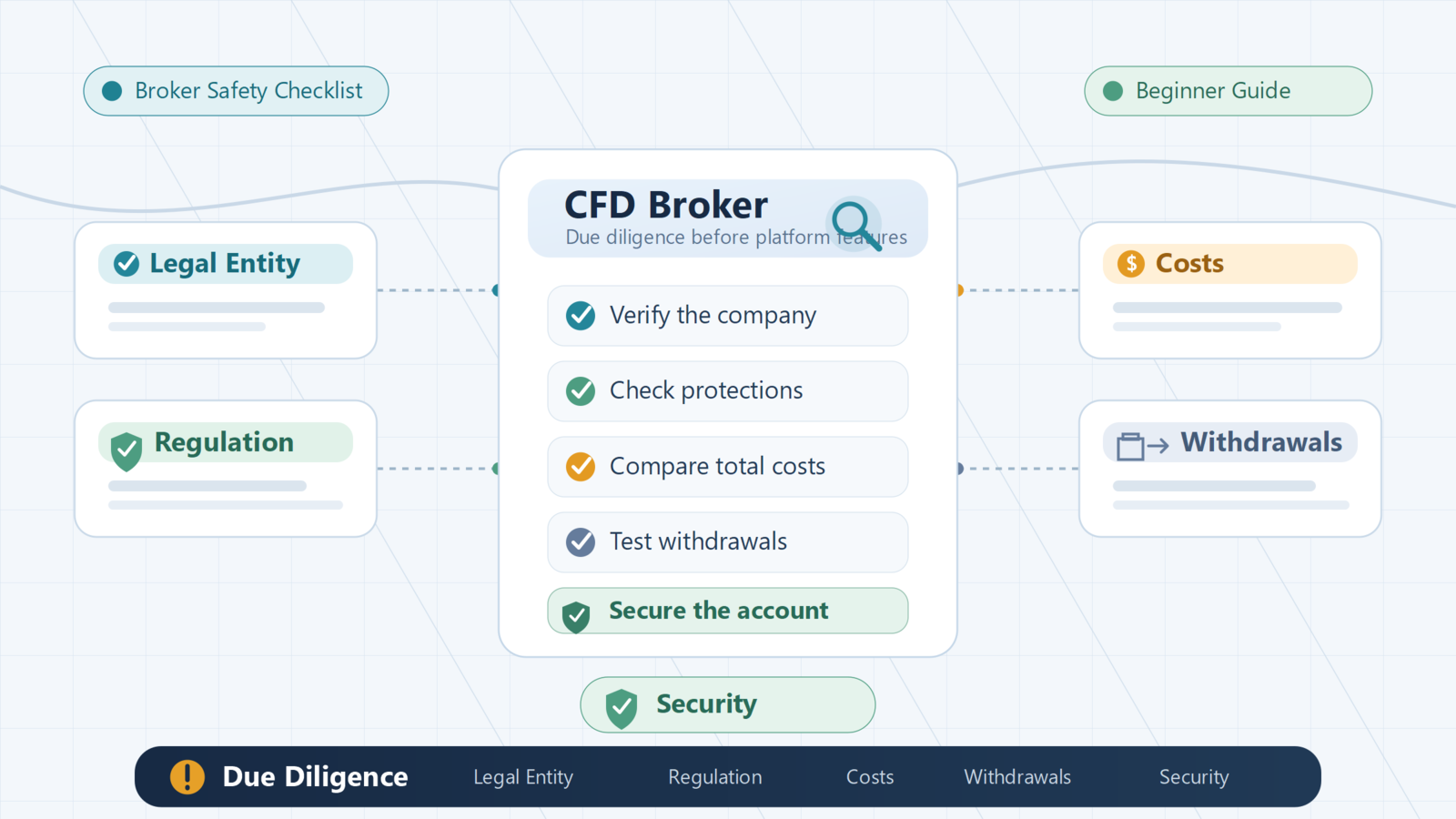
Focus Keyphrase: how to choose a CFD broker
Last updated: August 18, 2026
Target market: International English, with UK, Australia, Singapore and US availability notes
How to choose a CFD broker was the question I kept returning to. I stopped asking which platform looked easiest and started checking which legal entity would hold my account, whether that entity appeared on the relevant regulator’s register, what retail protections applied, and how much trading and withdrawal could actually cost. Only after those checks did I compare the platform, markets and demo account.
Risk warning: Contracts for Difference (CFDs) are complex, leveraged products and are not suitable for all retail investors. This guide is for education only. It does not recommend a broker, provide investment advice, or suggest that opening a CFD account is appropriate for you.
This article follows my beginner learning path after studying what CFD trading is, the small-account limits in whether you can trade CFDs with $100, and the ownership differences in CFDs versus stock ownership. The main lesson was simple: choosing a CFD broker is not mainly a platform-design decision. It is a legal-entity, protection, cost and risk decision.
Quick Facts
| Question | Short Answer |
|---|---|
| What did I check first? | The exact legal entity, regulator, licence status and permitted activities. |
| Did I choose the lowest spread? | No. A headline spread is only one part of total cost and may not represent normal market conditions. |
| Did regulation remove CFD risk? | No. Regulation can set conduct and retail-protection rules, but it does not prevent trading losses. |
| Why did the legal entity matter? | A brand may use different entities in different countries, with different rules and protections. |
| What platform features mattered? | Clear order tickets, margin information, fee disclosure, account security, stable access and a realistic demo environment. |
| What was my final test? | I asked whether I could explain the broker’s entity, costs, protections and close-out rules without relying on marketing claims. |
How to Choose a CFD Broker: My Starting Point
When I first compared CFD brokers, I looked at the visible features:
- the design of the trading app
- the number of available markets
- the minimum deposit
- the advertised spread
- charting tools
- account-opening speed
Those features were easy to compare, but they were not the best starting point.
In practical terms, how to choose a CFD broker starts with the exact company behind the account. A CFD account is a contract with a specific company. The company may be part of a larger brand, but the name on the website is not always the exact legal entity that will provide the account. Different entities within the same group may operate under different regulators, offer different protections and use different product terms.
That changed my first question about how to choose a CFD broker from:
Which CFD platform looks best?
to:
Which regulated legal entity would I actually be dealing with?
This became the foundation of my broker checklist.
How to Choose a Regulated CFD Broker
Before comparing spreads or charts, I looked for the company’s full legal name in the website footer, account agreement, terms and regulatory disclosure.
I did not treat a logo or brand name as enough. I wanted to know:
- the full company name
- the company or registration number
- the claimed regulator and licence number
- the registered website domain
- the country in which the account would be opened
- whether retail CFD dealing appeared within the firm’s permitted activities
I then checked the relevant regulator’s official register rather than trusting a badge displayed on the broker’s website.
For a UK firm, that meant checking the FCA Financial Services Register and confirming the contact details and website matched. For an Australian provider, that meant checking ASIC’s professional registers and the relevant Australian financial services licence information. For Singapore, I would use the MAS Financial Institutions Directory and verify the institution and regulated activity.
The matching step mattered because clone firms can copy the name or licence details of a real authorised business while using a different website, email address or phone number.
My Legal Entity Check
| Check | What I Wanted to Confirm |
|---|---|
| Legal name | The account agreement names the same company shown on the regulator’s register. |
| Website | The domain and contact details match official records or can be independently verified. |
| Licence status | The licence is current and not shown as revoked, suspended or unauthorised. |
| Permissions | The firm’s permissions cover the service and product being offered. |
| Client location | The entity is allowed to serve a client in my country. |
| Retail classification | I understand whether I would be treated as a retail, professional or other client type. |
If I could not complete this check, I stopped. A polished platform could not compensate for an unclear counterparty.
Retail Protections to Check When Choosing a CFD Broker
The word regulated sounded reassuring when I was new, but it was too broad to be useful by itself.
I needed to ask what the rules actually meant for my account. Depending on the jurisdiction and client classification, relevant protections may include leverage limits, margin close-out rules, negative balance protection, standardised risk warnings, restrictions on incentives, complaint procedures or rules around client money.
These protections do not make CFD trading safe. They define parts of the relationship between the provider and retail client. Market losses, gaps, slippage, financing costs and poor decisions can still damage an account.
I also learned not to assume that every entity using the same brand offers the same protection. If a website redirected me to an offshore or differently regulated entity, I would repeat the entire check rather than relying on the parent brand’s reputation.
Questions I Asked About Protection
- Does negative balance protection apply to this account and all relevant products?
- At what account-equity level can positions be closed?
- How does the provider calculate margin and available equity?
- How is client money handled?
- Which complaint and dispute-resolution process applies?
- Can the provider change margin requirements during volatile conditions?
- What happens if a market gaps or becomes unavailable?
- Does the agreement allow the provider to reject, cancel or reprice an order?
If the answers were spread across several documents, I collected them before making a decision.
How to Choose a CFD Broker by Comparing Total Costs
The lowest number on a comparison page was not necessarily the lowest-cost account.
A CFD position can involve several costs:
- bid-ask spread
- trading commission
- overnight financing or holding charges
- currency conversion
- market data or exchange fees
- guaranteed stop premiums, where offered
- inactivity or account administration fees
- deposit or withdrawal charges
- slippage between the expected and executed price
Some costs depend on the market, account type, position direction, holding period and market conditions. A broker may advertise a minimum spread that is not available at all times.
To make the comparison more realistic, I created one hypothetical scenario and applied it consistently to every provider. I used the same market, exposure, holding period, account currency and assumed opening and closing method. I did not use the result as a profit forecast. I used it only to understand the cost structure.
My Cost Comparison Table
| Cost | What I Checked | Why It Mattered |
|---|---|---|
| Spread | Typical or variable spread, not only the advertised minimum | The opening price may begin behind the market by the spread amount. |
| Commission | Per side, round trip, percentage or minimum charge | A low spread may be paired with a separate commission. |
| Overnight financing | Rate, benchmark, markup, calculation time and weekend treatment | Holding costs can accumulate and change the answer for multi-day positions. |
| Currency conversion | Conversion rate and markup | A different account or instrument currency can create an extra cost. |
| Withdrawal | Method, fee, minimum and expected processing time | Accessing funds is part of the full account experience. |
| Slippage | Execution policy and order handling | The requested price may not be the final execution price. |
This was where whether you can trade CFDs with $100 became important. A small deposit may be enough to meet a platform minimum, but it may leave little room for spread, financing, adverse movement and margin requirements. Minimum deposit and suitable account size are different questions.
How to Choose a CFD Broker Without Ignoring Execution
The next step was less exciting than testing charts, but more important: I read how orders were handled.
I wanted to understand whether the provider acted as principal, matched or hedged exposure elsewhere, used another execution venue, or applied another model described in its legal documents. I did not assume that one label automatically made a broker good or bad. I wanted the actual policy.
My questions included:
- How is the CFD price derived from the underlying market?
- Can spreads widen during volatility or outside the main market session?
- Can an order be partially filled, rejected or requoted?
- How are stop and limit orders handled during price gaps?
- What happens if the underlying market is suspended?
- Does the provider disclose material conflicts of interest?
- How are complaints about execution investigated?
I also looked for plain-language examples. If the policy was technically available but impossible to understand, that was a usability problem in itself.
How to Choose a CFD Broker for Withdrawals and Account Security
Fast deposits were heavily promoted. Withdrawals received less attention.
Before funding an account, I checked:
- whether deposits and withdrawals had to use the same source
- identity-verification requirements
- supported payment methods
- stated processing times
- possible third-party banking fees
- minimum withdrawal amounts
- reasons a withdrawal could be delayed
- account closure procedures
I would begin with a small operational test rather than transferring the full amount I might eventually use. The purpose would not be to start trading immediately. It would be to confirm that identity checks, statements, support and withdrawal instructions worked as described.
Security also mattered. I preferred providers that offered multi-factor authentication, login alerts, clear device management and a documented process for recovering an account. A trading platform is also a financial account, so convenience should not replace basic access security.
Step 6: I Used the Demo Account as a Product Test
A demo account can help a beginner learn the interface, order ticket and margin display. It cannot prove that live results will match demo results.
Demo environments may differ from live trading in execution, emotions, liquidity, slippage and the consequences of mistakes. I therefore used demo access to test the broker, not to prove that I was ready to trade.
My demo checklist included:
- Can I see the full position exposure before submitting an order?
- Is required margin displayed clearly?
- Can I find the spread, commission and overnight financing information?
- Does the ticket distinguish quantity, contracts, lots and monetary exposure?
- Can I view account equity, used margin and available margin?
- Are stop orders explained without implying guaranteed execution?
- Can I export statements and transaction history?
- Does the mobile interface show the same risk information as desktop?
If the platform made leverage feel invisible, I treated that as a warning. A beginner interface should make exposure easier to understand, not easier to ignore.
Step 7: I Tested Support With Difficult Questions
I did not only ask how quickly an account could be opened. I asked questions that required specific answers:
- Which legal entity would hold my account?
- Which regulator and licence apply?
- Where can I find the margin close-out rule?
- How is overnight financing calculated for this market?
- Which withdrawal fees or limits apply?
- What protection changes if I request professional-client status?
- Where is the execution policy?
I preferred written answers that pointed to the relevant official document. I was cautious when support relied on urgency, bonuses, vague reassurance or promises that risk controls would prevent losses.
Sales pressure was a negative signal. A broker should not need me to rush past documents I had not understood.
Red Flags That Would Make Me Stop
My checklist was not designed only to rank brokers. It was also designed to reject them.
I would stop the process if I found:
- no clear legal entity in the terms
- licence details that did not match the regulator’s register
- a domain, email or phone number inconsistent with official records
- pressure to deposit immediately
- promises of guaranteed or unusually easy returns
- a request to install remote-access software
- crypto-only funding without a clear explanation
- unclear withdrawal rules
- an offshore transfer presented as equivalent to stronger local retail protection
- bonuses that encouraged higher deposits or trading volume
- an account manager offering specific trade signals
- difficulty locating costs, margin rules or execution terms
No single platform feature would persuade me to ignore one of these red flags.
My CFD Broker Safety Scorecard
I used a simple scorecard to keep marketing features from dominating the decision.
| Category | Weight | My Pass Condition |
|---|---|---|
| Legal entity and licence | 25% | Entity, domain, licence and permissions independently verified. |
| Retail protections | 20% | Margin, close-out, balance, client-money and complaint rules understood. |
| Total costs | 20% | Spread, commission, financing, conversion and withdrawal costs compared. |
| Execution transparency | 15% | Pricing, slippage, order handling and conflicts explained. |
| Funding and withdrawals | 10% | Methods, verification, timing and fees are clear. |
| Platform and security | 5% | Exposure is visible and strong login security is available. |
| Support quality | 5% | Specific questions receive documented, non-pressured answers. |
The weights are not a universal formula. They show my priority order. Regulation and protection came before platform appearance because a better chart did not solve a legal-entity or withdrawal problem.
Region Notes: UK, Australia, Singapore and the US
United Kingdom
I would verify the firm on the FCA Financial Services Register, check that the contact details match, and review any warnings. UK retail CFD rules include measures such as leverage limits, margin close-out requirements, negative balance protection and standardised risk warnings. These protections reduce certain risks but do not make CFDs suitable for every beginner.
Australia
I would verify the provider and licence details through ASIC’s professional registers and read the Australian product disclosure and target market material. ASIC’s retail CFD product intervention measures include leverage limits, margin close-out protection, negative balance protection and restrictions on certain inducements.
Singapore
I would search the MAS Financial Institutions Directory for the institution and relevant regulated activity, then read the local account terms. MoneySense warns that CFDs are leveraged and that losses can exceed the initial margin in some circumstances, so I would not assume that a small margin defined the maximum risk.
United States
I would not assume that an offshore website could legally offer the same retail CFD product to a US person. Product availability and classification differ, and stock-based CFDs may fall within the US security-based swap framework. A US reader should verify legality and registration with the relevant US authorities rather than using an offshore account to bypass restrictions.
How to Choose a CFD Broker: How My Decision Changed
At the beginning, I thought choosing a CFD broker meant finding a platform with low spreads and a manageable deposit.
At the end, my decision looked different:
- Verify the legal entity.
- Verify the regulator, licence and permissions.
- Understand the protections attached to my exact account.
- Compare total cost using the same hypothetical scenario.
- Read execution, conflict and withdrawal terms.
- Test the platform and support without rushing to fund.
- Decide whether CFD trading itself is appropriate before choosing any provider.
That final point matters most. A careful answer to how to choose a CFD broker does not answer whether a beginner should trade CFDs. It only improves the due-diligence process. The separate suitability question is covered in whether CFDs are suitable for beginners.
FAQ
How to Choose a CFD Broker as a Beginner?
Start with the exact legal entity, regulator, licence and permissions. Then compare retail protections, total costs, execution rules, withdrawals, platform security and support. Do not begin with bonuses or app design.
Is a regulated CFD broker safe?
Regulation can provide conduct rules and retail protections, but it does not remove market risk, leverage risk, provider risk or the possibility of loss. Verify the specific entity and account terms.
What is the most important CFD broker check?
Confirm that the legal entity, website domain, contact details, licence status and permissions match the relevant regulator’s official register.
Should I choose the CFD broker with the lowest spread?
Not automatically. Compare the typical spread together with commission, overnight financing, currency conversion, withdrawal costs and execution quality.
Does a demo account show real CFD trading conditions?
Not completely. A demo can test the interface and help you learn order mechanics, but live execution, slippage, liquidity and emotional pressure may differ.
Can I use an offshore CFD broker?
Offshore access may involve different rules, protections and dispute options. It may also be restricted for residents of some countries. Verify local legality and do not assume an offshore entity offers the same protection as a local regulated entity.
Should I accept professional-client status for more leverage?
Not without understanding which retail protections may be lost. More leverage increases exposure and can increase losses. Never change classification only to access a larger position.
What documents should I read before opening a CFD account?
Read the client agreement, product disclosure, risk warning, costs and charges, margin and close-out policy, execution policy, conflicts disclosure, privacy policy and withdrawal terms.
Final Checklist
Before I would choose a CFD broker, I wanted to answer yes to every question below:
- Can I name the exact legal entity?
- Did I verify it on the official regulator’s register?
- Do the website and contact details match?
- Do I know which retail protections apply?
- Can I explain the margin close-out rule?
- Have I compared total cost rather than one spread?
- Have I read the execution and conflict policies?
- Do I understand withdrawal verification, timing and fees?
- Does the platform clearly show full exposure and margin?
- Did support answer difficult questions without pressure?
- Have I decided whether CFDs are suitable for me before choosing a provider?
If any answer was no, I was not ready to choose.
Risk Warning and Next Step
CFDs are complex, leveraged products and can cause rapid losses. Broker regulation and platform risk controls do not guarantee that a trade will be profitable or that losses cannot occur. Costs, margin changes, close-outs, slippage and market gaps can materially affect an account.
My next step would not be to select the broker with the most attractive promotion. It would be to verify the entity again, save copies of the relevant terms, use a demo account to test the interface, and decide whether the product is suitable at all.
This guide is educational. It does not recommend a broker, a jurisdiction, an account type or a trade.
Sources
- FCA: Check a firm or individual on the Financial Services Register
- FCA: Contract for differences
- ASIC: Professional registers search
- ASIC: CFD product intervention order takes effect
- MoneySense: Understanding contracts for difference
- MAS: Financial Institutions Directory
- SEC: Security-Based Swap Markets