
 tradeportx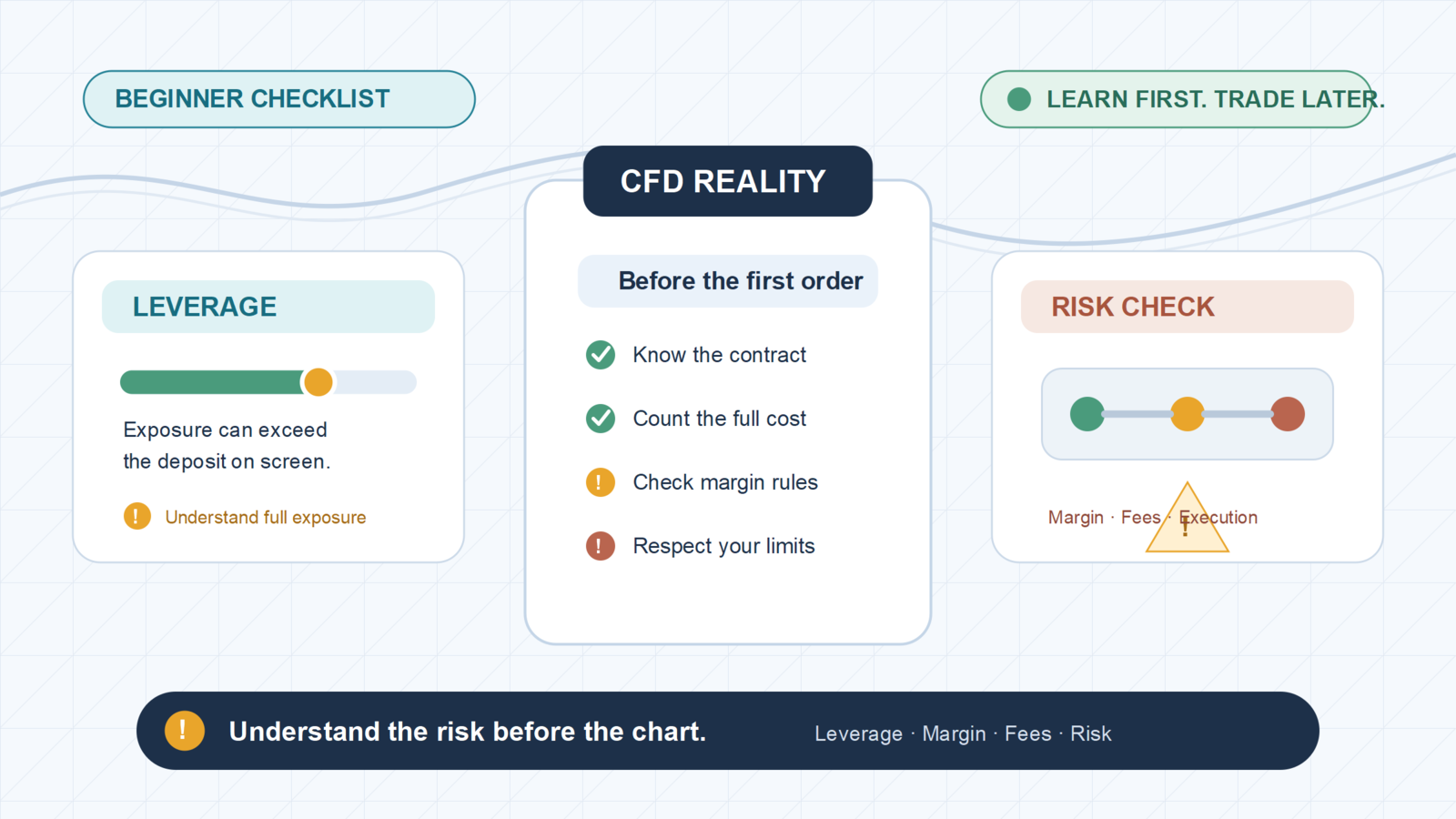
Focus Keyphrase: CFD beginner lessons
Last updated: August 19, 2026
Target market: International English, with UK, Australia, Singapore and US availability notes
One of the first CFD beginner lessons I learned is that the difficult part is not opening a chart or placing an order. The difficult part is understanding what the product is, how leverage changes the outcome, what the full cost can be, and what happens when a position moves against you faster than expected.
Risk warning: Contracts for Difference (CFDs) are complex, leveraged products and are not suitable for all retail investors. This guide is for education only. It does not recommend a broker, provide investment advice, or suggest that opening a CFD account is appropriate for you.
I started by learning what CFD trading is, then asking whether $100 is enough and comparing CFDs versus stock ownership. Those earlier questions were useful, but they still left out the practical lessons that matter when a beginner moves from reading about CFDs to considering a live account.
Quick Facts
| Question | Short Answer |
|---|---|
| What surprised me most? | A small deposit can control a much larger exposure, so a small price move can have a large effect on account equity. |
| Is the initial margin the maximum I can lose? | No. Margin is the amount required to open or maintain exposure, not a guarantee of the maximum loss. |
| Is the lowest spread always the cheapest option? | No. Commission, overnight financing, conversion costs, slippage and withdrawal fees may also matter. |
| Does a demo account prepare me completely? | No. It can teach the interface, but live execution and emotional pressure may be different. |
| Does regulation make CFDs safe? | No. Regulation may provide rules and protections, but losses and product risk remain possible. |
| What should I do first? | Learn the contract terms, calculate total exposure and decide whether the product is suitable before funding an account. |
CFD Beginner Lessons: The Product Was More Complex Than the Interface
The trading screen made CFDs look simple. I could choose a market, select a size and see a profit-and-loss number. That simplicity was misleading.
A CFD is a derivative contract based on the price movement of an underlying market. I was not automatically buying the shares, currency or commodity shown on the screen. I was entering a contract with a provider. That meant I needed to understand the contract specifications, pricing, margin rules, financing terms and close-out process before treating a trade as a simple purchase.
This was one of the most important CFD beginner lessons I would repeat to any beginner: an easy-to-use interface does not mean an easy-to-understand product.
If the difference between ownership and price exposure is still unclear, I would return to CFDs versus stock ownership and what CFD trading is before thinking about a live position.
Leverage Changes the Size of the Mistake
The next thing I wish I knew was that leverage does not only magnify a potential gain. It magnifies the effect of an adverse move as well.
For example, suppose a position gives exposure to $1,000 of an asset while the account uses $100 of margin. A 2% move in the underlying market is $20 on the full exposure. That is a 20% change relative to the $100 margin, before costs. The example is simplified, but it shows why the deposit alone does not describe the risk.
The question I should have asked was not:
How much money do I need to open this trade?
It was:
How much exposure am I taking, and what would a fast adverse move do after costs?
Leverage can make a position appear affordable when the underlying exposure is much larger. It can also make a series of small decisions consume an account faster than expected. That is why “low minimum deposit” should never be treated as “low risk”.
Margin Is Not a Safety Cushion
Margin is easy to misunderstand. I initially thought of it as money set aside to absorb a loss. In practice, it is usually part of the collateral required to maintain a leveraged position.
A broker may set an initial margin requirement and a maintenance or close-out level. If available equity falls below the relevant threshold, positions may be reduced or closed according to the provider’s terms. The exact rules vary by jurisdiction, account type, instrument and provider.
A forced close-out is not the same as a carefully chosen stop-loss. It may happen after a rapid move, during volatile conditions or at a price different from the level I had in mind. I therefore needed to read the broker’s margin and close-out policy instead of assuming the platform would give me unlimited time to respond.
CFD Beginner Lessons: The Spread Is Only One Part of Cost
I used to compare the advertised spread first because it was easy to see. I later realised that the total cost can include several separate items:
- spread or commission
- overnight financing or funding adjustments
- currency conversion
- inactivity or account fees, where applicable
- deposit and withdrawal charges, where applicable
- slippage or execution differences
- wider pricing during less liquid or more volatile conditions
One of the most practical CFD beginner lessons is to compare the complete cost of holding a position, not just the headline spread. A low headline spread does not automatically mean a low-cost account. The relevant question is whether I can estimate the cost of opening, holding and closing the specific product under normal and stressed conditions.
Overnight financing also changed how I thought about holding time. A position that looks inexpensive for a short period may become more expensive if held across multiple nights. That does not make every overnight position inappropriate, but it means the holding cost should be understood before the position is opened.
A Small Account Has Practical Limits
I also wish I knew that a small account is not simply a smaller version of a large account. With limited capital, fees and normal price fluctuations can represent a larger share of equity. The account may leave less room for several open positions, temporary drawdowns or a margin requirement increase.
That is why the question whether $100 is enough should be treated as a question about risk capacity and product mechanics, not just whether a broker accepts a $100 deposit.
A small deposit can make the financial commitment look modest while the market exposure is not modest. If the only reason to use leverage is that the account is too small to buy the underlying asset directly, that is a reason to slow down and compare alternatives, not a reason to increase risk automatically.
Demo Trading Has a Narrow Purpose
A demo account can be useful. It helped me learn where the order ticket was, how margin was displayed, how to close a position and where the platform showed financing or corporate-action adjustments.
But a demo account cannot reproduce everything:
- live liquidity and execution
- slippage and fast price gaps
- actual funding charges
- platform interruptions under pressure
- the emotional response to real losses
- the temptation to trade more because the money is not real
I would now use demo trading as an operational test, not as proof that I had a profitable strategy. The useful question is whether I can explain the order, exposure, margin, costs and exit process without guessing.
CFD Beginner Lessons: The Broker Check Comes Before the Platform Design
Before considering an account, I would check the exact legal entity, not just the brand name. I would compare the entity, domain, contact details, licence status and permitted activities against the relevant regulator’s official register.
I would also read the account agreement and product disclosure documents for:
- how client money is handled
- which retail protections apply
- negative balance protection, if applicable
- margin and close-out rules
- order execution terms
- funding and withdrawal conditions
- complaints and support procedures
This is the practical lesson from how I chose a CFD broker: regulation is important, but a regulatory label is not a substitute for reading the terms or understanding the risks. A regulated provider can still offer a product that is unsuitable for a particular person, and regulation cannot prevent a market loss.
Short-Term Decisions Can Become Emotional Decisions
The technical risks were only part of the problem. I also underestimated how quickly a leveraged position could affect my behaviour.
A losing trade can create an urge to wait for a reversal. A winning trade can create an urge to increase size. A missed move can create an urge to enter late. Each reaction can turn a planned decision into an emotional one.
I learned that a written process matters more than a confident feeling. Before considering a trade, I would want to know what the product is, why the exposure exists, what costs apply, what could invalidate the idea and how much loss I can tolerate. If I cannot explain those points, I am not ready to rely on a live leveraged position.
This is also why I would not use a CFD article as a substitute for personal financial advice. Suitability depends on financial circumstances, experience, objectives, jurisdiction and risk tolerance.
Regional Rules Change the Answer
CFD availability and retail protections are not identical everywhere. The entity serving an account, the user’s location, the instrument and the account classification can all affect the applicable terms.
Readers in the UK, Australia and Singapore should check the current rules and disclosures for their own jurisdiction. Useful starting points include the FCA CFD information, ASIC CFD guidance and MoneySmart CFD education. US readers should not assume that a website offering CFDs abroad can lawfully provide the same product to a US retail customer; the SEC security-based swaps information explains why the framework is different. The relevant US regulatory framework is different, and availability should be verified through official sources rather than a marketing page.
A country selector on a website is not enough. I would confirm the legal entity and the applicable client agreement before relying on any statement about leverage, protection or availability.
CFD Beginner Lessons: What I Would Check Before Funding an Account
My checklist would now be:
- Can I explain the CFD contract without calling it ownership?
- Can I calculate the full exposure rather than only the margin?
- Do I understand spread, commission, financing and conversion costs?
- Do I know the margin call and forced close-out rules?
- Have I checked the exact legal entity and official regulatory register?
- Have I read the withdrawal, complaints and client-money terms?
- Am I using a demo account to learn mechanics rather than predict results?
- Would a loss affect essential expenses or money I cannot afford to lose?
- Is there a simpler, unleveraged product that better matches my goal?
If several answers are no, the next step is more research, not a live deposit.
Is CFD Trading Worth It for Beginners?
After learning these lessons, I would not describe CFDs as a default beginner product. Whether CFDs are worth it for beginners depends on the person’s knowledge, financial situation, goals, jurisdiction and ability to manage leveraged risk. My earlier article whether CFDs are worth it for beginners explores that suitability question in more detail.
The important distinction is between being interested in CFDs and being prepared to trade them. Interest may justify reading and practising. It does not automatically justify taking leveraged market exposure.
FAQ
What are the most important CFD beginner lessons?
Understand that CFDs are leveraged derivative contracts, not usually ownership of the underlying asset. Learn the full exposure, margin rules, close-out process, trading costs, financing charges and provider terms before considering a live account.
Are CFDs difficult for beginners?
The platform may be easy to use, but the product can be difficult to manage. Beginners need to understand leverage, margin, rapid losses, financing and execution before treating CFDs as suitable.
Can I lose more than my initial deposit in CFDs?
It depends on the applicable jurisdiction, account protections and provider terms. Do not assume that a deposit is a maximum-loss limit. Check whether negative balance protection applies and understand the relevant close-out and exceptional-market conditions.
Is a demo account enough before trading CFDs?
No. A demo can help with platform mechanics and order handling, but it may not reproduce live execution, liquidity, slippage, costs or emotional pressure.
Are CFDs cheaper than buying stocks?
Not automatically. CFDs may have different spreads, commissions, financing charges, conversion costs and provider terms. Direct stocks also have costs, so the comparison should use the full cost and the different ownership structure.
Does regulation make CFD trading safe?
No. Regulation may create conduct standards and retail protections, but it cannot remove market risk, leverage risk, provider risk or the possibility of loss.
Risk Warning and Next Step
CFDs are complex, leveraged products. You can lose money rapidly, and the product may not be suitable for you. This article is general education, not investment advice or a recommendation to open an account.
The lesson I would keep is simple: before trading CFDs, understand the contract before the chart, the full exposure before the deposit, the total cost before the headline spread, and your own limits before the first live order.