
 tradeportx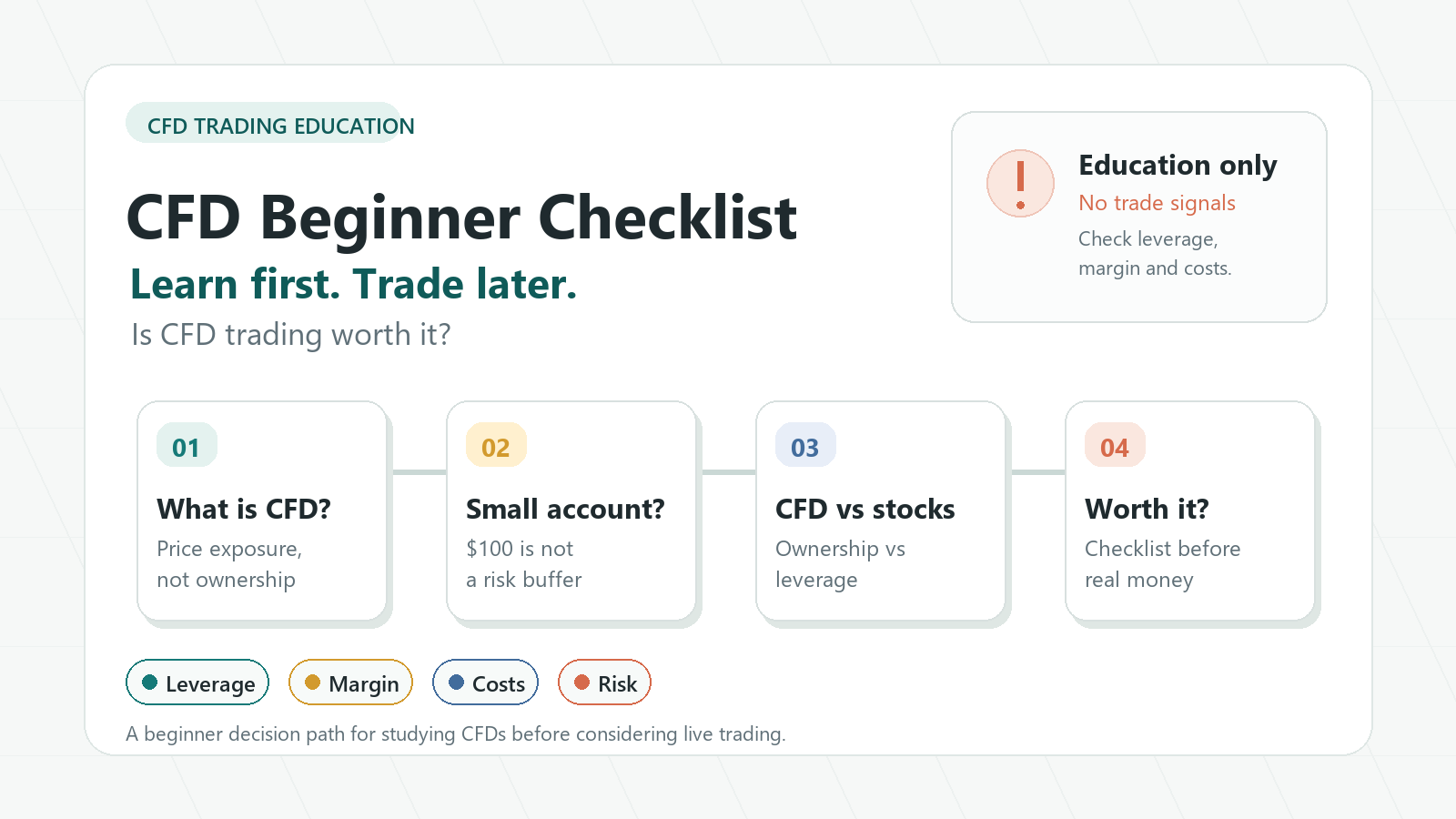
Focus Keyphrase: is cfd trading worth it
Last updated: August 3, 2026
Target market: Global English / worldwide English-speaking audience, with region-specific notes for UK, Australia, Singapore and US availability or regulatory differences
Is CFD trading worth it for beginners? My answer is: worth learning, but not automatically worth trading with real money. When I first studied CFDs, the product looked simple because you can speculate on price movements without owning the asset and may start with a small margin. The part I nearly underestimated was leverage. CFDs can magnify losses, trigger margin calls or close-outs, and add costs such as spreads, commissions and overnight financing.
Risk warning: Contracts for Difference (CFDs) are complex, leveraged products and are not suitable for all retail investors. This article is for education only and does not provide investment advice, trading signals or a recommendation to trade CFDs.
Quick Facts
| Question | Short Answer |
|---|---|
| Is CFD trading worth it for beginners? | It may be worth learning, but it is not automatically worth live trading. |
| What should beginners learn first? | What a CFD is, how leverage and margin work, what costs apply, and how close-outs can happen. |
| Can you trade CFDs with $100? | Possibly on some platforms, but $100 is usually a very small risk buffer after margin, costs and market movement. |
| Is CFD trading better than stocks? | Not automatically. Stocks usually involve ownership; CFDs provide leveraged price exposure without ownership. |
| What data should beginners notice? | ASIC reported that in the 2024 financial year, 68% of Australian retail CFD investors lost money. |
| Is this a US CFD trading guide? | No. US readers should treat this as educational only because stock-based CFDs may fall under the US security-based swap framework. |
My Short Answer: Is CFD Trading Worth It for Beginners?
The cleanest way I would answer this question is:
CFDs are worth learning because they teach important ideas about leverage, margin, market exposure, short selling and trading costs. But they are not automatically worth trading with real money, especially for a beginner who cannot yet explain the product without using platform marketing language.
That distinction matters.
When I first looked at CFD trading, the attractive part was obvious. The product seemed flexible. You could go long or short. You did not need to buy the underlying asset. The margin requirement could look smaller than the full position size. On the surface, that made CFDs feel more accessible than buying stocks outright.
The mistake was that I was looking at access before I understood exposure.
A small margin does not mean a small trade. It means you are putting down collateral for a larger market exposure. If the market moves against you, the loss is linked to that larger exposure, not only to the initial margin. Once I understood that, the question changed from:
Can I start CFD trading?
to:
Do I understand this product well enough to survive being wrong?
That is the question a beginner should answer before treating CFD trading as worth it.
Step 1: What Is CFD Trading in Plain English?
A Contract for Difference (CFD) is a derivative contract. Instead of buying the underlying asset, you trade the price difference between opening and closing the position.
If you trade a stock CFD, you do not normally own the company shares. If you trade a gold CFD, you do not own physical gold. If you trade an index CFD, you do not own the shares inside the index. You are trading price exposure through a contract with a provider.
That was my first learning hurdle. I had to stop thinking of a CFD as “buying the market” and start thinking of it as “taking a contract-based exposure to price movement.”
The difference sounds small, but it changes the whole risk picture:
- You may not have ownership rights.
- You may use leverage.
- You may need margin to open and maintain a position.
- You may pay spread, commission or overnight financing.
- You may face margin calls or close-outs if the market moves against you.
- You need to check the provider’s product terms instead of assuming every CFD works the same way.
In Singapore’s MoneySense investor education material, CFDs are described as products where traders do not own the underlying share or asset, and where margin calls, financing costs and product complexity are central risks. That is the right beginner framing: a CFD is not just another button beside a stock order. It is a leveraged derivative contract.
Once I understood that, the next question became more practical.
Is CFD Trading Worth It With $100? Why the Small Account Question Can Mislead Beginners
The next thing many beginners ask is whether they can trade CFDs with a small amount, such as $100.
That question is useful, but it can also mislead you. I would not start with “Can $100 open a trade?” I would start with “What does $100 have to survive?”
What $100 Has to Cover
A small CFD account has to cover more than the deposit:
- the provider’s minimum deposit
- the product’s minimum trade size
- the margin requirement
- the spread
- any commission
- overnight financing if the position is held after the daily cut-off
- currency conversion
- slippage in fast markets
- enough remaining equity to handle normal price movement
This is why I now separate three ideas:
| Question | What It Really Means | Why Beginners Misread It |
|---|---|---|
| Can I deposit $100? | Whether the platform accepts that account funding amount | It says nothing about whether the account has enough risk buffer. |
| Can I open a CFD trade with $100? | Whether the minimum trade size and margin allow a position | It says nothing about whether the position is sensible. |
| Is $100 enough to trade CFDs safely? | Whether the account can absorb costs and adverse movement | This is the real question, and the answer is often uncomfortable. |
Why Possible Is Not the Same as Suitable
If you want the detailed version of that question, see Can you trade CFDs with $100. The short version is that possible does not mean suitable.
This was one of the easiest traps for me to spot once I wrote the numbers down. A low margin requirement can make a small account look powerful, but it also means a normal market move can become a large percentage of the account.
For example, if a $100 account controls $500 of CFD exposure, a 5% adverse move on the exposure is about $25 before costs. That is already 25% of the $100 account. Add spread, commission or financing, and the buffer becomes even thinner.
That does not mean every small account loses money. It means the account has less room for normal mistakes.
Is CFD Trading Worth It Compared With Stocks?
After the $100 question, the next question I would ask is whether CFD trading is better than stock trading.
I do not think that is the right wording. CFDs and stocks are different products. They are not just two versions of the same thing.
Stocks usually involve ownership. If you buy shares directly, you may own part of a company and may receive shareholder rights such as dividends or voting rights, depending on the market and share class.
Stock CFDs usually provide price exposure without ownership. You may be able to go long or short, and you may use leverage, but you normally do not own the underlying shares.
For a beginner, that difference matters more than the platform interface.
Ownership Versus Price Exposure
| Beginner Question | Stocks | Stock CFDs |
|---|---|---|
| Do I own the underlying company shares? | Usually yes in direct share ownership | Usually no |
| Do I usually pay the full position value in a simple cash account? | Usually yes | Usually no; margin is commonly used |
| Can leverage magnify losses? | Not usually in a simple cash stock account | Yes, leverage is a central risk |
| Are there shareholder rights? | May include voting rights or dividends | No normal shareholder rights; possible contract adjustments |
| Is the product simple for long-term ownership? | Usually simpler | Usually not designed for simple long-term ownership |
| What costs matter? | Brokerage, exchange fees, custody, tax or FX costs | Spread, commission, overnight financing, conversion costs and possible platform fees |
This is why I would not ask, “Is CFD trading better than stocks?” I would ask:
Do I want ownership, or do I want leveraged price exposure?
If you want the full comparison, see CFD vs stocks. For this article, the key point is simple: CFDs may look more flexible, but that flexibility comes with extra complexity.
CFD Trading Worth It Checklist: Costs I Would Check First
The next pitfall is cost.
When I first looked at CFDs, I focused too much on the margin requirement and not enough on the total cost of holding and closing the trade. That is a beginner mistake because costs can quietly decide whether a small trade has any room to breathe.
Costs That Can Change the Answer
CFD costs may include:
- bid-ask spread
- commission, especially on some share CFDs
- overnight financing
- currency conversion
- platform or data fees
- slippage during fast markets
- charges for certain risk-management features, depending on the provider
The holding period matters. A very short trade may be more sensitive to spread and commission. An overnight or multi-day position may be more sensitive to financing costs. A trade in a foreign market may add currency conversion costs.
The mistake is saying “CFDs are cheaper” or “CFDs are expensive” without a specific product, provider and holding period.
The better beginner question is:
What is the total cost of this exact CFD position if I am right, wrong, flat or forced to close early?
My Cost Checklist
Here is the cost checklist I would use before deciding a CFD trade is worth even practising:
| Cost or Friction | What I Would Check | Why It Matters |
|---|---|---|
| Spread | Difference between buy and sell price | The trade may start at a small loss because of the spread. |
| Commission | Whether the product charges a separate fee | Common on some share CFDs. |
| Overnight financing | Daily cost or credit for holding after cut-off | Can make long holding periods expensive. |
| Currency conversion | Whether account and product currencies differ | Can add hidden cost to international products. |
| Minimum trade size | Smallest position allowed | Can make a small account overexposed. |
| Margin rate | Required collateral for the position | Decides exposure and remaining buffer. |
| Slippage | Possible execution difference in fast markets | Can make losses larger than expected. |
This is also why a demo account is useful, but not perfect. A demo can help you learn order types, margin and platform layout. It may not fully teach emotional pressure, real liquidity conditions or the pain of actual losses.
Is CFD Trading Worth It After Looking at Retail Risk Data?
The biggest shift in my thinking came from reading regulator materials instead of only broker education pages.
ASIC reported in January 2026, based on the 2024 financial year, that 68% of Australian retail CFD investors lost money. The same ASIC release said total losses were over A$458 million, including A$73 million in fees.
That statistic does not prove what will happen to any single person. It does not mean every CFD trade is a loss. But it does make the beginner question more serious.
If many retail clients lose money in a regulated market, then a beginner should not treat CFDs as an easy entry point just because the platform is accessible.
The UK Financial Conduct Authority (FCA) has also restricted retail CFD products with measures such as leverage limits, margin close-out rules, negative balance protection and standardised risk warnings. Those rules exist because leverage can create rapid losses for retail clients.
The lesson I took from these sources is not “never learn CFDs.” The lesson is:
If regulators keep focusing on leverage, margin and retail losses, those are exactly the topics a beginner must understand before deciding CFDs are worth it.
My Beginner Checklist: When CFD Trading May or May Not Be Worth It
I would not use a simple yes or no answer. I would use three levels.
| Situation | My Decision | Why |
|---|---|---|
| I do not understand what a CFD is | Not worth live trading | I cannot manage a product I cannot explain. |
| I think margin is the maximum loss | Not worth live trading | That is a dangerous misunderstanding. |
| I only have a very small account and no risk buffer | Usually not worth live trading | Costs and normal market movement can pressure the account quickly. |
| I want long-term ownership and dividends | Stocks or ETFs may be simpler | CFDs usually do not provide normal ownership. |
| I understand exposure, margin, close-outs and costs | Worth further study or demo practice | Knowledge is improving, but live risk still needs caution. |
| I can calculate the position’s full exposure and worst-case stress scenarios | Possibly worth considering in a limited, risk-controlled way | This still depends on jurisdiction, provider terms and personal risk tolerance. |
| I am using a demo account to learn mechanics | Worth learning | Demo practice can reveal mistakes before real money is involved. |
The most useful line in this table is the first one: I cannot manage a product I cannot explain.
That sentence would have saved me from several beginner assumptions:
- low margin does not mean low risk
- high leverage does not mean high skill
- a demo win does not prove a live edge
- short selling access does not remove risk
- a small deposit does not make the product beginner-friendly
- platform availability does not mean personal suitability
Common Mistakes I Would Avoid as a CFD Beginner
If I were starting again, these are the mistakes I would actively avoid.
Mistake 1: Thinking CFD trading is just faster stock trading
A stock CFD is not the same as owning a stock. You are trading a derivative contract, not buying the company. That affects ownership rights, costs, tax treatment, risk and suitability.
Mistake 2: Looking at margin instead of exposure
The margin number can feel like the trade size, but it is not. The trade’s profit and loss are linked to the full exposure.
Mistake 3: Ignoring overnight financing
If a beginner holds CFD positions overnight, financing costs can matter. This is especially important for anyone who thinks they can use CFDs like long-term stocks.
Mistake 4: Treating $100 as proof the product is accessible
A small account may be accepted by a platform, but the real question is whether it can survive margin requirements, costs and normal volatility.
Mistake 5: Confusing learning with readiness
Reading a few pages about CFDs can make the product feel understandable. Real readiness means being able to calculate exposure, explain risk, understand costs and know what happens when the market moves against you.
Mistake 6: Using regulator warnings as fine print
Regulator warnings are not decoration. They are signals about the product’s risk profile. If the warning says many retail clients lose money, a beginner should slow down.
Region Notes: UK, Australia, Singapore and US
CFD rules and availability depend on the reader’s location. This article is written for international education and does not describe a trading offer in any specific country.
| Region | How I Would Frame CFD Trading for Beginners | Important Compliance Note |
|---|---|---|
| UK | Available through regulated providers, but treated as high-risk retail products | FCA rules include retail protections such as leverage limits, margin close-out, negative balance protection and risk warnings. |
| Australia | Available under product intervention conditions, with recent retail loss data worth reading | ASIC reported 68% of retail CFD investors lost money in the 2024 financial year. |
| Singapore | Available but treated as a complex product | MoneySense explains CFD margin, margin calls, costs and Customer Knowledge Assessment context. |
| US | Do not treat this as a US CFD trading guide | Stock-based CFDs may fall under the US security-based swap framework. |
For UK, Australia and Singapore readers, the main point is that availability does not equal suitability.
For US readers, the caution is stronger. Stock-based CFDs should not be treated as ordinary retail stock products. The SEC has brought proceedings involving stock-based CFDs offered to US retail investors as security-based swaps. This article is educational and does not present a US CFD trading offer.
So, Is CFD Trading Worth It for Beginners?
My practical answer is:
CFD trading is worth learning if you want to understand leverage, margin, short exposure, trading costs and risk control. It is not automatically worth live trading, and it is usually not the first product I would choose for someone who only wants simple long-term investing.
I would put beginners into three groups:
| Beginner Type | Is CFD Trading Worth It? | Better Next Step |
|---|---|---|
| Just heard about CFDs and wants to try quickly | Not worth live trading yet | Learn what CFDs are and use a demo account. |
| Understands stocks but not leverage or margin | Worth learning, not live trading | Compare CFD vs stocks and study margin examples. |
| Has a small account and wants high exposure | Usually not worth live trading | Study small-account risk and cost drag first. |
| Can explain exposure, margin, close-outs and costs | Possibly worth continued study | Check jurisdiction, product specs and risk controls. |
| Wants ownership, dividends or long-term investing | CFDs may not fit the goal | Compare direct stocks or ETFs. |
That is the most honest way I can frame it. CFDs are not automatically bad, but they are easy to misunderstand. For beginners, misunderstanding is the danger.
FAQ
Is CFD trading worth it for beginners?
It may be worth learning, but beginners should not assume it is worth live trading. CFDs are leveraged products with margin, costs and close-out risk.
Is CFD trading good for beginners?
Usually not as a first live trading product. CFDs can be useful for education and demo practice, but real-money CFD trading is complex and high risk.
Can you trade CFDs with $100?
Possibly on some platforms and products, but $100 is usually a small risk buffer once margin, spreads, commissions, financing and market movement are considered.
Is CFD trading better than stocks?
Not automatically. Stocks usually involve ownership, while CFDs provide leveraged price exposure without ownership. The better choice depends on your objective and risk understanding.
Should beginners trade CFDs?
Most beginners should study CFDs carefully and practise in a demo environment before considering live trading. If you cannot explain leverage, margin, costs and close-outs, you should not rush.
Are CFDs worth learning?
Yes, CFDs can be worth learning because they teach leverage, margin, short exposure and risk management. Learning does not mean the product is suitable for live trading.
What is the biggest CFD mistake beginners make?
The biggest mistake is focusing on the small initial margin instead of the full market exposure. Losses are linked to the exposure, not only the deposit or margin.
Are CFDs suitable for long-term investing?
Usually not for simple long-term ownership. Overnight financing, leverage and contract structure can make CFDs unsuitable for beginners who want to buy and hold assets.
Risk Warning and Next Step
CFDs are complex, leveraged products and can result in rapid losses. They may involve margin calls, close-outs, overnight financing, spreads, commissions, slippage and provider-specific terms. This guide is educational and does not recommend trading CFDs, choosing a platform or taking any market position.
If you are asking whether CFD trading is worth it for beginners, I would not make the next step a live trade. I would make the next step a learning test:
- Can I explain what a CFD is?
- Can I calculate full exposure from margin?
- Can I explain what happens during a margin call or close-out?
- Can I list all likely costs before opening a position?
- Can I explain why CFD trading is different from buying stocks?
- Can I use a demo account without treating demo results as proof of live skill?
- Can I accept that the product may be worth learning but still not suitable for me?
If the answer to any of those questions is no, then CFD trading may still be worth studying, but it is not yet worth risking real money.