
 tradeportx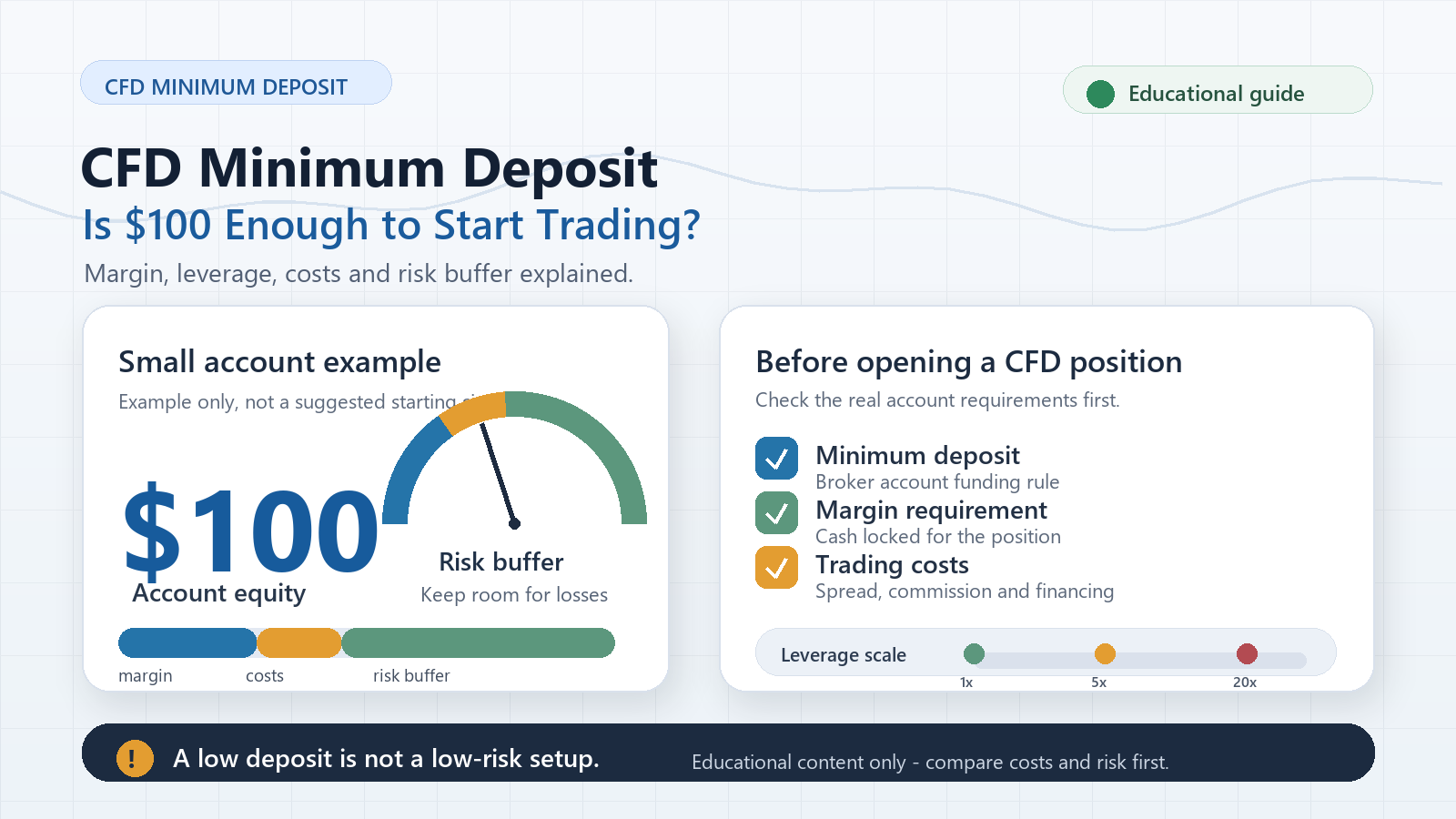
Focus Keyphrase: CFD minimum deposit
Last updated: July 30, 2026
Target market: International English, with UK, Australia and Singapore context, plus a separate US availability note
CFD minimum deposit is only one part of the real starting-cost question. Yes, you may be able to trade some CFDs with $100, but that does not mean $100 is a safe or comfortable amount to start with. A small CFD account has to cover the provider’s minimum deposit, minimum trade size, margin requirement, spread, commission, overnight financing and price movement. Because CFDs use leverage, losses are calculated on the full market exposure, not only on the margin you deposit.
Risk warning: Contracts for Difference (CFDs) are complex, leveraged products and are not suitable for all retail investors. This article is for education only and does not provide investment advice, trading signals or a recommendation to trade CFDs.
When I first looked at small-account CFD trading, the $100 question felt like a simple yes-or-no problem: either the platform allowed it or it did not. That was the wrong starting point. The better learning question is whether $100 gives enough room for margin, costs and normal market movement after the trade is open. This article uses that learning path, not a “small account strategy.”
Quick Facts
| Question | Short Answer |
|---|---|
| Can you trade CFDs with $100? | Possibly on some platforms and products, but $100 is usually a very small risk buffer. |
| What decides whether $100 is enough? | Minimum deposit, minimum trade size, margin requirement, leverage, costs and local rules. |
| Does leverage make $100 safer? | No. Leverage can increase market exposure, but losses are also based on that larger exposure. |
| What costs matter most? | Spread, commission, overnight financing, currency conversion, platform fees and slippage. |
| Is this a US CFD trading guide? | No. US readers should treat this as educational only because stock-based CFDs may fall under the US security-based swap framework. |
Short Answer: Is $100 Enough After the CFD Minimum Deposit?
The honest answer is: sometimes, but not always, and not comfortably.
You may find CFD platforms or products where $100 is enough to fund an account or place a small margin trade. But that is only the first test. A beginner should not ask only whether $100 can open a position. The better question is whether $100 can survive normal market movement, trading costs and margin requirements without being closed out quickly.
A $100 CFD account has to pass several gates:
- the provider’s minimum deposit
- the product’s minimum trade size
- the initial margin requirement
- the available free margin after opening the trade
- the bid-ask spread
- any commission or platform fee
- overnight financing if the trade is held after the daily cut-off
- currency conversion if the account and product are in different currencies
- enough buffer for normal price movement
If any one of those items is too large relative to the account, $100 may be technically accepted but practically too small.
The mistake I would avoid now is treating “accepted by the platform” as “suitable for me.” If I had only $100, I would treat it as a learning constraint first. I would want to know exactly how much exposure the smallest possible trade creates, how much free margin remains, and how much a normal price move could reduce the account before I thought about using real money.
What a CFD Minimum Deposit Has to Cover Before You Place a Trade
A common beginner mistake is treating minimum deposit and margin as the same thing. They are different.
A CFD minimum deposit is only the first gate. The account still needs enough room for the position size, margin, costs and normal price movement.
If you want the broader ownership-versus-leverage context first, see CFD vs stocks.
A minimum deposit is the amount required to fund an account. A provider may require a certain amount before the account can be used. That number does not automatically mean every product on the platform can be traded sensibly with that amount.
A minimum trade size is the smallest position the platform allows. For example, a CFD platform may let you trade a fraction of a contract, a mini lot or a minimum number of units. If the minimum trade size creates too much exposure for a $100 account, the account may be too small even if the deposit itself is accepted.
A margin requirement is the amount of money required to open or maintain a CFD position. Margin is not a fee. It is collateral for the leveraged position. The trade’s profit and loss are still linked to the full market exposure, not only the margin amount.
A risk buffer is the money left after opening the position. This is where $100 often becomes uncomfortable. If almost all of the account is tied up as margin, a small adverse move, spread cost or financing charge can create pressure quickly.
How Margin and Leverage Change a CFD Minimum Deposit
CFDs are leveraged products. Leverage can make a small account look larger than it is, but it does not remove risk.
A simple formula is:
\text{Theoretical exposure} = \frac{\text{Account equity}}{\text{Margin rate}}
If a product requires 20% margin, a $100 account could theoretically support up to about $500 of exposure before costs. If a product requires 5% margin, $100 could theoretically support up to about $2,000 of exposure before costs.
That does not mean you should use the full amount. It only shows the math. Using all available margin leaves little room for price movement, spread, commission or financing costs.
When I run this calculation as a beginner, I do not use it to find the largest possible trade. I use it to see how quickly a small account can become fragile. If the theoretical exposure looks surprisingly large, that is a warning sign to slow down and check the downside, not a reason to increase the position.
Regulators restrict retail CFD leverage in several major markets because leverage can cause rapid losses. The UK Financial Conduct Authority (FCA), the Australian Securities and Investments Commission (ASIC) and the European Securities and Markets Authority (ESMA) all describe retail CFD protections such as leverage limits, margin close-out rules, negative balance protection or standardized risk warnings.
For a beginner, the key lesson is this: leverage may reduce the upfront margin, but it also makes the account more sensitive to market movement.
CFD Minimum Deposit Examples by Leverage Level
The table below is an educational example only. It does not recommend any position size, product or platform. Actual margin requirements depend on the provider, asset class, account classification and local regulation.
| Margin Rate | Approx. Leverage | $100 Theoretical Exposure Before Costs | Beginner Risk Note |
|---|---|---|---|
| 3.33% | 30:1 | About $3,000 | Very small market moves can be large relative to a $100 account. |
| 5% | 20:1 | About $2,000 | Still highly sensitive to price movement and costs. |
| 10% | 10:1 | About $1,000 | A 5% adverse move would be about $50 before costs. |
| 20% | 5:1 | About $500 | A 5% adverse move would be about $25 before costs. |
| 50% | 2:1 | About $200 | Lower leverage, but costs can still matter on a $100 account. |
The important point is not that $100 can control a larger position. The important point is that a larger position can move against the account quickly.
For example, suppose a beginner opens a $500 CFD exposure using $100 of account equity. A 5% adverse move on the $500 exposure is about $25 before costs. That is already 25% of the $100 account. If there is also a spread, commission or overnight financing cost, the account pressure becomes even higher.
This is why a $100 account can feel very fragile. A normal market move can become a large percentage loss because the account is small.
Why a CFD Minimum Deposit Is Not the Same as a Safe Starting Amount
A provider’s minimum deposit only tells you the minimum amount needed to fund the account. It does not tell you whether the account size is appropriate for the product.
A safe or comfortable starting amount depends on more practical questions:
- How much exposure does the minimum trade size create?
- What margin rate applies to that product?
- How much free margin remains after opening the trade?
- What is the average spread?
- Is there a commission?
- Is there overnight financing?
- How volatile is the product?
- What happens if the position moves against you by 1%, 2%, 5% or more?
- When can the provider close the trade because margin is insufficient?
With only $100, there may be little room for mistakes. If the minimum trade size is too large, the position may use too much margin. If the spread is wide, the account starts at a noticeable disadvantage. If the position is held overnight, financing costs can matter more because the account is small.
This is why CFD minimum deposit needs a careful answer. A low deposit may be possible, but possible is not the same as suitable.
CFD Minimum Deposit Costs That Matter More in a Small Account
Costs matter in every trading account, but they matter more when the account is small.
A $2 cost on a large account may be minor. A $2 cost on a $100 account is 2% of the account. If several small costs appear together, they can reduce the account before the market has moved much.
Common CFD costs may include:
- spread between buy and sell prices
- commission, especially on some share CFDs
- overnight financing for positions held after the daily cut-off
- currency conversion
- platform or market data fees
- slippage in fast markets
- charges for certain risk-management features, depending on provider terms
Stock, ETF or other non-CFD products may have different costs, such as brokerage commission, exchange fees, custody costs, tax or foreign exchange conversion. The point is not that CFDs are always cheaper or more expensive. The point is that the total cost must be checked for the exact product, account and holding period.
Before placing a CFD trade, a beginner should find the provider’s product specification and fee schedule. If those pages are unclear, the user does not yet know whether $100 is enough.
What Can Go Wrong With a $100 CFD Account?
A small CFD account can fail for reasons that are easy to overlook.
The first risk is overusing leverage. If a beginner uses most of the available margin, a small market move can take a large part of the account. The position may be closed out even if the original trading idea still seems possible.
The second risk is confusing margin with maximum loss. Margin is the amount required to open or maintain the position. It does not mean the market can only move by that amount. Losses are linked to the full exposure.
The third risk is cost drag. Spread, commission, overnight financing and conversion costs can be large as a percentage of $100. A trade may need to move favorably just to overcome the initial cost.
The fourth risk is product complexity. Different CFDs can have different contract sizes, minimum trade sizes, trading hours, margin rates and financing rules. A beginner who understands one example may still misunderstand another product.
The fifth risk is false comfort from negative balance protection. In some regulated retail CFD jurisdictions, negative balance protection may limit retail losses to account funds. That does not prevent losing the full account quickly. It also may not apply the same way for professional clients, non-retail clients or accounts outside those rules.
Region Notes: UK, Australia, Singapore and US
CFD rules and availability depend on the reader’s region. This article is written for international education and does not describe a trading offer in any specific country.
| Region | How to Understand CFDs | Important Compliance Note |
|---|---|---|
| UK | CFDs are available through regulated providers but treated as high-risk retail products. | FCA rules include retail protections such as leverage limits, margin close-out, negative balance protection and risk warnings. |
| Australia | Retail CFDs are available under product intervention conditions. | ASIC applies leverage limits by asset class and other retail protections. |
| Singapore | CFDs are treated as complex products. | MoneySense explains CFD margin, margin calls, costs and customer knowledge assessment context. |
| US | Do not treat this as a US CFD trading guide. | Stock-based CFDs may implicate the US security-based swap framework. |
For UK, Australia and Singapore readers, the main message is that CFD availability does not mean suitability. A product can be available and still be too complex or too risky for a beginner using only $100.
For US readers, the caution is stronger. Stock-based CFDs should not be treated as ordinary retail stock products. The SEC’s security-based swap materials are relevant when discussing stock-based CFD exposure in the US context. This article is educational and does not present a US CFD trading offer.
A Safer CFD Minimum Deposit Checklist Before Using Real Money
This is the checklist I would use to slow myself down before treating a small deposit as a trading account. It is not a signal to trade. It is a filter for deciding whether I understand the product well enough to keep studying.
Before using even $100 of real money, a beginner should be able to answer these questions clearly:
| Check | Why It Matters |
|---|---|
| What is the minimum deposit? | You need to know whether the account can be funded. |
| What is the minimum trade size? | This controls whether a small account can place a genuinely small trade. |
| What margin rate applies? | Margin determines how much exposure the account can control. |
| What is the full exposure? | Losses are linked to exposure, not just margin. |
| What are the spread and commission? | Costs can be large as a percentage of $100. |
| Is there overnight financing? | Holding leveraged CFDs overnight can add daily cost. |
| When can margin close-out happen? | The provider may close positions if equity falls below required levels. |
| Is the product available in your region? | CFD rules differ by jurisdiction. |
| Have you tried a demo account? | A demo can help you learn mechanics before risking real money. |
| Can you afford to lose the full $100? | A small account can be lost quickly. |
If you cannot answer those questions, $100 should be treated as a learning budget at most, not as a comfortable trading account.
Is a Demo Account Better Before Using a Small CFD Minimum Deposit?
For many beginners, yes.
A demo account cannot reproduce every real-money emotion or execution condition, but it can help you understand the mechanics before you risk cash. You can learn how margin changes when the price moves, how unrealized profit and loss affect equity, how spreads appear on entry, and how overnight financing is shown.
A useful learning sequence is:
- Learn what a CFD is.
- Learn the difference between margin and exposure.
- Learn how leverage affects gains and losses.
- Check the provider’s minimum trade size and fees.
- Use a demo account to test order entry and margin changes.
- Only then decide whether real money is appropriate.
The goal is not to turn $100 into a large account. The goal is to avoid misunderstanding a leveraged product.
FAQ
Can I start CFD trading with $100?
Possibly on some platforms and products, but $100 is a very small account size. You must check minimum deposit, minimum trade size, margin rate, costs and whether CFDs are available in your region.
Is $100 enough for CFD trading?
It may be enough to open or margin a very small position in some cases, but it is usually not enough for a comfortable risk buffer. Normal price movement and trading costs can quickly reduce a $100 account.
How much margin do I need for CFDs?
Margin depends on the asset class, provider, jurisdiction and product. Some retail CFD rules use leverage ranges such as 30:1 to 2:1 by asset class, but providers may apply stricter requirements.
Can you lose more than $100 trading CFDs?
In some regulated retail CFD jurisdictions, negative balance protection may limit losses to account funds. Rules and account classifications differ, and you can still lose the full $100 quickly. Professional, non-retail or offshore terms may be different.
Is CFD trading good for beginners with a small account?
Usually, beginners should be cautious. CFDs add leverage, margin calls, close-outs, overnight financing and product complexity. A demo account and education about costs and margin are usually more appropriate before using real money.
What is the minimum amount to trade CFDs?
There is no universal minimum amount. It depends on the provider’s account rules, minimum deposit, minimum trade size, margin rate and the product you want to trade. Always check the exact product specification.
Does leverage make $100 enough for CFD trading?
Leverage can make $100 control a larger position, but that also increases sensitivity to price movement. Leverage does not make the trade safer.
Should I use the full $100 as margin?
Using all or nearly all account equity as margin leaves little room for spread, commission, financing costs or adverse price movement. That can increase the chance of margin pressure or close-out.
CFD Minimum Deposit Risk Warning and Next Step
CFDs are complex, leveraged products. They can involve rapid losses, margin calls, close-outs, overnight financing and costs that beginners may underestimate. This guide is educational and does not recommend trading CFDs, choosing a platform or using $100 as a starting amount.
If you are asking whether you can trade CFDs with $100, the next step is not to place a live trade. The next step is to check:
- the exact product specification
- minimum deposit
- minimum trade size
- margin rate
- spread and commission
- overnight financing
- regional availability
- margin close-out rules
- whether a demo account is available
A careful beginner should understand those items before using real money.