
 tradeportx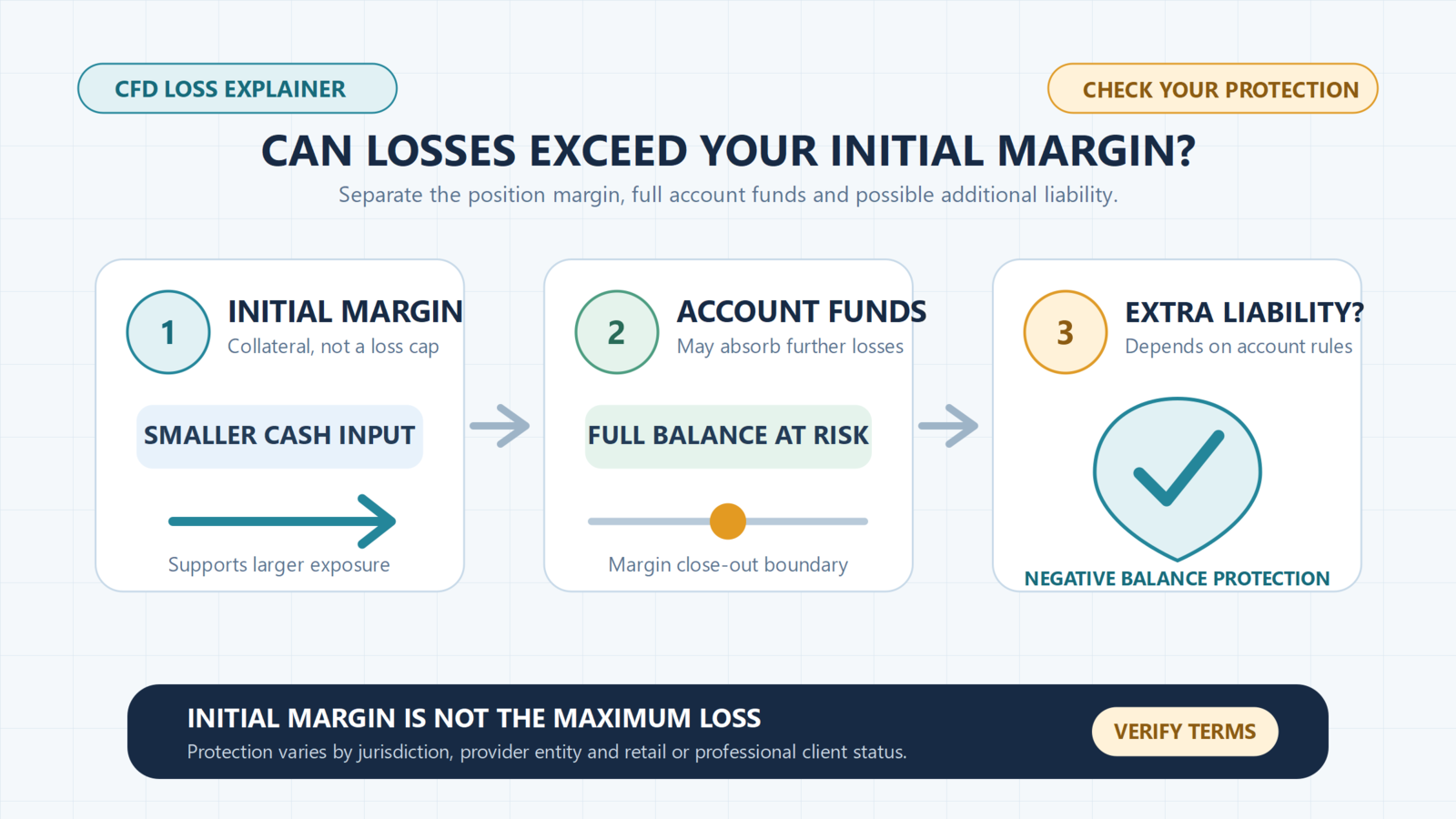
Focus Keyphrase: lose more than you invest
Last updated: August 24, 2026
Target market: Global English / worldwide English-speaking audience, with specific notes for the UK, EU, Australia, Singapore and the US
Can you lose more than you invest in CFDs? You can lose more than the initial margin used to open a CFD position. Whether you can lose more than all the money in your CFD account—or owe additional money beyond the account—depends on your jurisdiction, client classification, provider entity and the protection that legally applies.
For many retail CFD clients under UK, EU or Australian protections, negative balance rules are designed to limit losses to the funds in the CFD trading account. That does not make the trade safe. A trader may still lose the entire account balance, including money added after opening the position. Professional clients, clients of offshore entities and customers in other jurisdictions may have different protections.
Risk warning: Contracts for Difference (CFDs) are complex, leveraged products and can cause rapid losses. This article is educational only and does not provide investment advice, legal advice, trading signals or a recommendation to use CFDs.
Quick Facts
| Question | Short Answer |
|---|---|
| Can you lose more than the initial CFD margin? | Yes. Initial margin is collateral for a larger position, not a maximum-loss limit. |
| Can you lose your whole CFD account balance? | Yes. Close-out rules reduce risk but do not guarantee that part of the balance will remain. |
| Can a retail CFD account go below zero? | It can temporarily display a negative balance during fast markets or processing, but applicable negative balance protection may require the provider to reset the protected retail account. |
| Can you owe a CFD broker more money? | Possibly, if negative balance protection does not apply because of the jurisdiction, legal entity, client classification or product terms. |
| Does a stop-loss prevent extra losses? | No. A normal stop-loss may execute at a worse price during gaps or fast markets. |
| Does negative balance protection make CFDs safe? | No. It can limit account-level liability, but a trader can still lose all protected account funds. |
The Short Answer: Can You Lose More Than You Invest?
The question sounds simple, but the word “invest” can refer to three different amounts:
- Initial margin: the collateral required to open one position.
- Account balance: all funds held in the CFD trading account.
- Total personal liability: the amount the provider may legally seek beyond the account balance.
These amounts should not be treated as interchangeable.
If I deposit $1,000 and use $200 as margin, I have not limited the position’s loss to $200. The remaining account funds may support the position as losses grow. Depending on the provider’s rules, the position may be closed when the account reaches a margin threshold, but fast price movement can make the final result worse than expected.
This is why the accurate answer is:
- More than the initial margin? Yes.
- More than the total CFD account balance? The account can be depleted, and the outcome depends on applicable protections.
- More than all money held in the account, creating an additional debt? Possible where negative balance protection does not apply.
Why You Can Lose More Than You Invest Beyond Initial Margin
CFDs commonly use leverage. Margin allows a trader to control market exposure larger than the cash set aside for the position.
A simplified relationship is:
\text{Notional Exposure} = \frac{\text{Initial Margin}}{\text{Margin Rate}}
For example, if a position requires $200 of margin at a 5% margin rate:
\text{Notional Exposure} = \frac{\$200}{0.05} = \$4{,}000
A 5% adverse move on $4,000 of exposure is approximately:
\$4{,}000 \times 5\% = \$200
That simplified price loss equals the initial margin before spreads, commissions, overnight financing, slippage or other adjustments. If the account contains additional available funds, the loss may continue beyond the original $200 margin before the position is closed.
The lesson is not that a particular 5% move will always produce this exact outcome. Product specifications, position sizing, currency conversion and provider rules vary. The reason you can lose more than you invest as initial margin is that loss is linked to full exposure, not only to the margin displayed on the order ticket.
This connects directly with Can you trade CFDs with $100?. A small required deposit does not mean the account has enough room for normal price movement and costs.
Can You Lose Your Entire CFD Account Balance?
Yes. Negative balance protection should not be confused with protection from losing the account balance.
A retail account may contain:
- cash not currently assigned as initial margin
- unrealised profits or losses
- margin supporting several open positions
- funds added during a margin call
- financing and transaction costs
As positions move against the trader, available funds can shrink. A provider may issue a margin warning, restrict new positions or close positions under its margin close-out rules. However, the exact trigger and execution process depend on the provider and applicable regulation.
Even when negative balance protection applies, its purpose is generally to prevent the protected account from creating an additional liability beyond the account’s funds. It does not promise that the trader will keep the original deposit.
What Is Negative Balance Protection?
Negative balance protection is an account-level safeguard designed to limit a protected retail client’s aggregate CFD liability. In practical terms, it can prevent the client from being required to pay more than the funds committed to the protected CFD account.
The wording “account-level” matters. It is not necessarily a separate guarantee for every position. Profits and available funds elsewhere in the same CFD account may offset losses before the protection is relevant.
It also does not eliminate:
- the possibility of losing the full account balance
- rapid losses before positions are closed
- spread, commission and financing costs
- slippage or market gaps
- losses in another account or product
- disputes about whether the client or account qualifies
The safest way to understand the protection is to read the provider’s legal documents and identify:
- the regulated legal entity holding the account
- the jurisdiction governing the agreement
- whether the account is retail or professional
- which products are covered
- whether separate accounts are aggregated
- exclusions involving misconduct, abuse or prohibited activity
Margin Close-Out Is Not the Same as Negative Balance Protection
These protections address related but different stages of risk.
| Protection | Main Purpose | What It Does Not Guarantee |
|---|---|---|
| Margin close-out | Requires or causes positions to be closed when account funds fall to a defined level relative to required margin | An exact exit price or preservation of a particular balance |
| Negative balance protection | Limits qualifying account liability so a protected retail client does not owe more than the account funds | Protection from losing the full account balance |
| Stop-loss order | Requests an exit when the market reaches a chosen level | Execution at the requested price during gaps or fast markets |
| Guaranteed stop, where offered | May guarantee an exit level under specific provider terms and fees | Protection from other positions, costs or account-level losses |
A trader should not use one control as a substitute for the others. A stop-loss does not replace position sizing. Margin close-out does not replace a personal loss limit. Negative balance protection does not make a leveraged product suitable.
A Gap-Risk Example
Imagine a CFD position is open when the underlying market closes. Unexpected news appears before the next session, and the market reopens far below the previous price.
The sequence may look like this:
- The market skips over the normal stop-loss price.
- The position closes at the next available executable price.
- The realised loss is larger than the trader planned.
- The account balance may fall sharply or temporarily below zero.
- Whether an additional debt remains depends on applicable negative balance protection and account terms.
This is called gap risk. It is one reason why a normal stop-loss should not be described as a guaranteed maximum-loss tool.
When Could You Lose More Than You Invest and Owe More?
Additional liability may be possible in situations such as:
1. You are classified as a professional client
Retail protections may be reduced or unavailable after a client elects or qualifies for professional status. Higher leverage should not be viewed separately from the protections that may be lost.
2. Your account is with an offshore or different legal entity
A familiar brand can operate through several legal entities. The website design may look identical while the governing rules and client protections differ.
3. Your jurisdiction does not require account-level negative balance protection
CFD regulation is not uniform worldwide. A risk warning from one country should not be assumed to apply to an account opened elsewhere.
4. The product is outside the relevant protection
The account may include products governed by different rules. Read the exact scope rather than assuming every leveraged product receives the same treatment.
5. The provider alleges an exclusion under the agreement
Terms may address fraud, market abuse, prohibited trading practices or account misuse. This article cannot determine how a provider or court would apply those terms to a specific dispute.
If the legal entity, classification or protection is unclear, do not rely on a marketing summary. Check the client agreement and the regulator’s register before funding the account.
Region Notes: UK, EU, Australia, Singapore and the US
United Kingdom
The FCA’s permanent retail CFD restrictions include leverage limits, a 50% margin close-out rule and protection preventing a client from losing more than the total funds in the CFD trading account. These protections apply to retail clients under the relevant UK regime; professional-client treatment can differ.
European Union
ESMA’s CFD product intervention framework established leverage limits, margin close-out and negative balance protection on a per-account basis for retail investors. National competent authorities subsequently implemented permanent measures in their jurisdictions, so readers should check the regulator governing the actual account.
Australia
ASIC’s CFD product intervention order includes leverage limits, a margin close-out requirement and negative balance protection for retail clients. The order was extended to remain in force until May 23, 2027. Account holders should still verify the provider’s Australian legal entity and retail classification.
Singapore
MoneySense explains that CFD losses can exceed the initial margin and that investors may be required to meet margin calls. Do not assume UK, EU or Australian negative balance rules automatically apply to a Singapore account. Check the provider’s authorisation, customer agreement and risk disclosure.
United States
This is not a US CFD availability guide. Stock-based CFDs may involve the US security-based swap framework, and products marketed internationally should not be assumed to be legally available to US retail customers.
| Region | Retail Protection Summary | Main Check |
|---|---|---|
| UK | Account-level negative balance protection forms part of retail CFD restrictions | Confirm FCA entity and retail status |
| EU | Retail framework includes per-account negative balance protection | Confirm the national regulator and account entity |
| Australia | Retail CFD order includes negative balance protection | Confirm ASIC-regulated entity and current order terms |
| Singapore | Initial-margin losses and margin calls are key disclosed risks | Read the local account agreement; do not import foreign protections |
| US | Treat international CFD content as education, not evidence of availability | Check the US legal framework and product status |
My Checklist Before Relying on Negative Balance Protection
I would not rely on a platform badge or a short FAQ. I would find written answers to all of these questions:
- What is the full legal name of the provider entity?
- Which regulator supervises that entity?
- Am I classified as a retail or professional client?
- Does the agreement explicitly provide negative balance protection?
- Is the protection per position, per account or across multiple accounts?
- Does it cover every CFD product I can access?
- What is the provider’s margin close-out level?
- Can a normal stop-loss slip during a market gap?
- What exclusions appear in the client agreement?
- What complaint and compensation routes apply?
If I cannot answer those questions, I would treat “you cannot lose more than your deposit” as an unverified marketing claim.
Common Beginner Misunderstandings
“My margin is $200, so I can only lose $200”
Incorrect. The margin supports a larger exposure, and other funds in the account may absorb additional losses.
“Negative balance protection means my deposit is protected”
Incorrect. The whole protected CFD account balance may still be lost.
“The broker will always close my trade before zero”
Not guaranteed. Fast markets, gaps and execution conditions can affect the closing price.
“A stop-loss fixes the maximum loss”
A normal stop-loss may experience slippage. Only a genuinely guaranteed stop under its specific terms can guarantee a chosen exit level.
“The same brand means the same protection everywhere”
Not necessarily. The legal entity and jurisdiction—not only the brand—determine the applicable account agreement and protections.
“Professional status is simply an upgrade”
It may provide access to different leverage or terms, but it can also remove retail safeguards. The trade-off needs to be understood before accepting reclassification.
Final Answer: Can You Lose More Than You Invest in CFDs?
My final answer is:
- You can lose more than the initial margin assigned to a CFD position.
- You can lose all the money held in the CFD account.
- You may owe money beyond the account if negative balance protection does not apply.
- Qualifying retail clients under UK, EU and Australian CFD rules generally receive account-level negative balance protection, but the exact legal entity, client classification and terms must be verified.
The practical mistake is asking only, “How much margin do I need?” If you want to know whether you can lose more than you invest, the safer questions are:
What is my full exposure, how much of my account can be lost, and what written rule limits any liability beyond the account?
FAQ
Can you lose more than your deposit with CFDs?
You can lose more than the margin used for one position and may lose the full CFD account balance. Whether you can owe more than the account depends on applicable negative balance protection, jurisdiction, provider entity and client status.
Can a CFD account go negative?
A CFD account may temporarily show a negative balance during extreme movement or processing. Where qualifying retail negative balance protection applies, the provider should apply the account-level protection according to the governing rules and agreement.
What happens if I cannot meet a CFD margin call?
The provider may restrict the account or close some or all positions under its margin close-out rules. The execution price may differ from the price visible before the close-out.
Does negative balance protection cover every CFD trader?
No. It may apply only to qualifying retail clients under particular regulated entities and jurisdictions. Professional clients and customers of other entities may receive different protection.
Can a stop-loss prevent a negative CFD balance?
Not always. A normal stop-loss can execute at a worse price during market gaps or fast conditions. It should not be treated as a guaranteed account-level loss limit.
Can professional CFD traders lose more than their account balance?
Potentially. Professional clients may not receive the same negative balance protection as retail clients. The exact position depends on the provider, jurisdiction and client agreement.
Does negative balance protection make CFD trading safe?
No. It may limit additional account liability, but traders can still lose the full balance rapidly because CFDs use leverage and involve costs and execution risk.
Are CFDs available to retail traders in the US?
Do not assume international CFD products are available to US retail customers. Stock-based CFDs may involve the US security-based swap framework, and product legality must be checked separately.
Risk Warning and Next Step
CFDs are complex, leveraged products and can cause rapid losses. Margin close-out and negative balance protection reduce specific risks but do not prevent the loss of the full CFD account balance. Product availability, legal protections and provider terms differ by jurisdiction and client classification.
Before considering real money, read What Is CFD Trading, What I Wish I Knew Before Trading CFDs and My First Week Trading CFDs. Then identify the provider entity, retail or professional status, margin close-out rule and negative balance wording in the actual client agreement.