
 tradeportx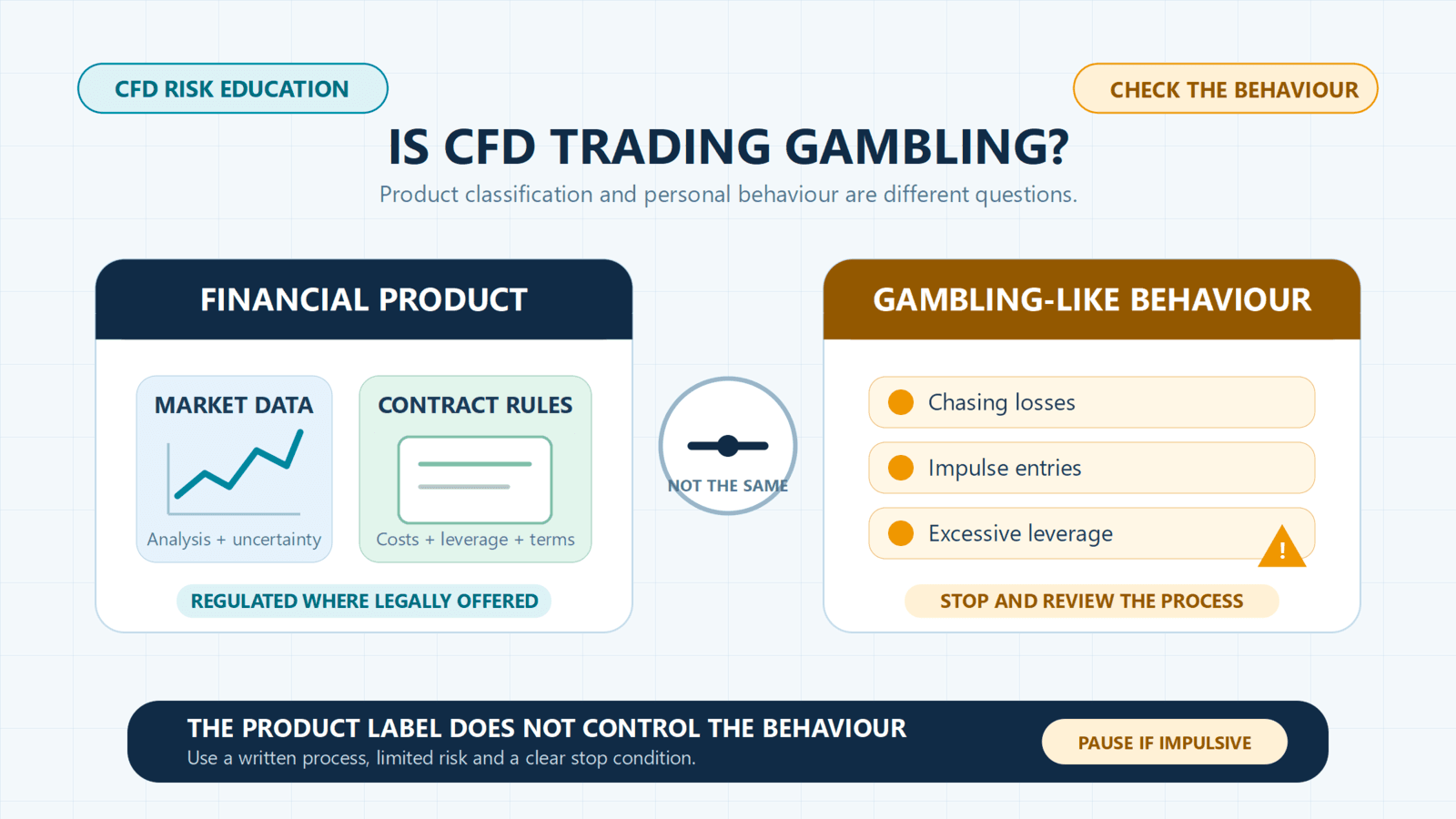
Focus Keyphrase: is CFD trading gambling
Last updated: August 31, 2026
Target market: Global English / worldwide English-speaking audience, with region-specific notes for the UK, Australia, Singapore and the US
Is CFD trading gambling? Not in the usual legal or product sense. A CFD is a regulated financial derivative in jurisdictions where retail CFD trading is permitted. But the way a person trades CFDs can become gambling-like when decisions are driven by excitement, impulse, chasing losses or oversized leverage instead of a defined process and risk limit.
That distinction matters. Calling every CFD trade gambling ignores the difference between a financial contract and a casino game. Calling CFD trading an investment does not make reckless behaviour disciplined. The product classification and the trader’s behaviour are two separate questions.
Risk warning: Contracts for Difference (CFDs) are complex, leveraged products and can cause rapid losses. This article is educational only. It does not provide investment advice, trading signals, a psychological diagnosis or a recommendation to trade CFDs.
Quick Facts
| Question | Short Answer |
|---|---|
| Is CFD trading gambling legally? | CFDs are generally treated as financial derivatives where regulated, not ordinary casino gambling. Local law and product availability still differ. |
| Can CFD trading become gambling-like? | Yes. Impulsive entries, chasing losses, excessive leverage and trading for excitement can resemble gambling behaviour. |
| Does having a strategy prove it is not gambling? | No. A written strategy can improve discipline, but it does not prove the strategy has an edge or remove uncertainty. |
| Is CFD trading based only on luck? | No. Markets can be analysed, but short-term outcomes remain uncertain and skill is difficult to separate from chance over a small sample. |
| Do most retail CFD traders make money? | No. Regulators repeatedly report that a majority of retail CFD clients lose money. ASIC reported that 68% of Australian retail CFD investors lost money in the 2024 financial year. |
| Does risk management guarantee success? | No. It limits selected risks; it cannot guarantee profitable execution or prevent every loss. |
Is CFD Trading Gambling? My Short Answer
My answer has two parts:
- The product is a financial derivative, not a casino game. A CFD creates contract-based exposure to the price movement of an underlying market without usually giving ownership of that asset.
- The behaviour can still become gambling-like. If I trade without a reason, increase risk after losses, seek excitement or depend on one lucky outcome, the fact that the platform is regulated does not make my process disciplined.
When I first studied CFDs, I thought the difference between trading and gambling was whether the trader used a chart. That was too simple. A chart can support analysis, but it can also become a screen on which a trader projects hope.
The better test is not:
Am I using a financial platform?
It is:
Do I have a repeatable decision process, a measurable risk limit and a reason to believe my approach is better than random action after costs?
Why CFD Trading Is Not Legally the Same as Gambling
A CFD is a derivative contract. The result is based on the difference between the opening and closing value of the contract, adjusted for spreads, commissions, financing and other provider terms.
Financial regulators supervise CFD providers in markets where retail CFDs are permitted. Their rules may address authorisation, disclosure, leverage, margin close-out, marketing and negative balance protection.
In the UK, CFDs are regulated by the FCA as high-risk financial products. The UK Gambling Act also excludes certain regulated financial activities from its legal definition of betting. That does not mean a CFD is safe; it means the activity sits within a financial regulatory framework rather than ordinary gambling regulation.
The distinction is important but limited:
- Legal classification answers which regulatory framework applies.
- Economic structure explains how the contract, costs and counterparty arrangement work.
- Personal behaviour determines whether the trader is acting systematically or impulsively.
A regulated product can still be used recklessly. A legal label cannot tell me whether one trade was sensible.
CFD Trading vs Casino Gambling
| Feature | CFD Trading | Casino Gambling |
|---|---|---|
| Basic activity | Trading a derivative linked to a financial market | Wagering on a game or event under gambling rules |
| Information available | Market prices, company data, economic releases and technical information may be analysed | Rules and probabilities are usually fixed by the game |
| Expected advantage | A trader must establish whether a repeatable edge exists after costs | The operator normally has a defined mathematical house advantage |
| Costs | Spread, commission, financing, slippage and other terms | House edge, stake structure or explicit fees |
| Leverage | Common and capable of magnifying losses | Not normally described as financial margin, though stakes can escalate |
| Regulation | Financial regulator where the product is permitted | Gambling regulator under local law |
| Main behavioural risk | Overtrading, chasing losses, leverage escalation and false confidence | Chasing losses, impulsive betting and escalating stakes |
The table does not prove CFD trading is superior to gambling. It shows that the mechanisms differ. A trader can analyse a market and still make a poor decision. A casino player can understand the odds and still choose to gamble. The existence of information does not guarantee that it is used well.
When Is CFD Trading Gambling-Like?
CFD trading becomes gambling-like when the decision process starts to resemble wagering for excitement or emotional relief rather than a controlled financial activity.
Trading without a defined reason
If the only explanation is “the chart looks ready to move,” the trade may be based on intuition rather than a testable idea. A valid reason does not have to be complicated, but it should be written before the position is opened.
Chasing losses
After a loss, a trader may increase position size or open another trade immediately to “get the money back.” This changes the objective from executing a process to repairing an emotion.
Increasing leverage for excitement
Leverage can make a small market movement feel meaningful. If the position size is chosen to create excitement rather than to fit a risk limit, the behaviour is gambling-like even if the underlying market is real.
Depending on one outcome
A trader who needs one position to pay rent, repay debt or recover a large drawdown is no longer treating uncertainty as manageable. The position has become a rescue attempt.
Measuring skill from a few wins
A short winning streak can occur through favourable market conditions or chance. Treating several wins as proof of skill can lead to larger positions before the process has been tested.
Hiding the activity or its losses
Secrecy, repeated deposits and avoiding account statements are warning signs that the activity may no longer be controlled. This article is not a clinical assessment, but those signs should not be dismissed as ordinary trading discipline.
Is CFD Trading Gambling If You Have a Strategy?
Not automatically—but the word “strategy” is easy to misuse.
A strategy is more than an entry signal. At minimum, it should define:
- the market and conditions in which it applies
- the reason for entry
- the position size
- the planned exit or invalidation condition
- maximum loss per position and across the account
- costs included in the calculation
- situations in which no trade should be opened
- how results will be recorded and reviewed
Even then, a strategy is not proof of an edge. A trader needs a meaningful sample of results and must include spreads, commissions, financing and slippage. A rule that worked in one week may fail in a different market regime.
This is why My First Week Trading CFDs focused on learning the product rather than counting wins. Demo profits and short samples can reveal platform mechanics, but they do not establish long-term skill.
Skill, Chance and the Problem of Short Results
CFD trading contains elements that can be influenced by skill:
- selecting when not to trade
- controlling position size
- understanding the contract and costs
- following a predefined exit
- reviewing a consistent data set
- adapting a process when evidence changes
It also contains uncertainty that cannot be removed:
- unexpected news
- gaps and slippage
- changing volatility
- liquidity conditions
- correlation changes
- execution and provider-specific risks
The difficult part is separating skill from luck. A profitable result does not prove the decision was good, and a losing result does not prove it was irrational. The process and the result must be reviewed separately.
A useful journal asks:
- Did the trade meet the written rules?
- Was the full exposure understood?
- Were all costs included?
- Was the loss inside the planned limit?
- Would I make the same decision again using only the information available at entry?
Is CFD Trading Gambling Without Risk Management?
Trading CFDs without risk management is more likely to resemble gambling because the trader has no defined boundary between an ordinary loss and an account-threatening event.
Risk management should cover more than a stop-loss. A practical framework includes:
- position sizing based on account risk rather than margin availability
- a maximum planned loss for one position
- a maximum combined exposure across correlated positions
- a daily or weekly stop condition
- rules for market gaps and overnight holding
- a ban on adding risk merely to recover a loss
- enough unused account funds to understand margin pressure
Risk management does not create a profitable strategy. It controls how much damage a wrong decision can cause.
This also connects with Can you lose more than you invest in CFDs?. Initial margin is not the maximum loss, and negative balance protection does not protect the account balance from being depleted.
The Provider Does Not Need You to Lose Every Trade
A common argument is that CFD trading must be gambling because the provider earns money when customers trade. The reality depends on the provider’s execution and hedging model, but costs exist regardless of whether the trader wins one position.
Providers may earn through:
- spreads
- commissions
- overnight financing
- currency conversion
- other disclosed account or product charges
Some CFD providers act as the counterparty to client positions and may hedge some or all exposure under their own risk model. This creates conflicts that should be understood and disclosed, but it does not mean every provider controls the underlying market or that every winning trade is impossible.
The beginner’s practical question is simpler:
Can my method overcome uncertainty and all trading costs without relying on a lucky sequence?
If that has not been demonstrated, frequent trading may primarily transfer money through costs while increasing behavioural pressure.
My CFD Gambling-Like Behaviour Checklist
This checklist is educational, not diagnostic. The more “yes” answers I record, the more seriously I should consider stopping and reviewing the activity.
| Question | Yes / No |
|---|---|
| Am I trading mainly because I feel bored, stressed or excited? | |
| Do I enter positions without a written reason? | |
| Do I increase size after a loss to recover money quickly? | |
| Have I deposited more money because a margin call felt urgent? | |
| Am I using funds needed for bills, debt or emergencies? | |
| Do I hide losses or trading time from other people? | |
| Do I keep trading after reaching my planned stop? | |
| Do I judge skill from a few wins rather than a documented sample? | |
| Do I focus on potential profit while ignoring full exposure and costs? | |
| Would I feel restless or distressed if I could not trade today? |
If several answers are yes, the next step should not be a larger position. It should be a pause, removal of easy funding access, a review of account statements and support from an appropriate financial, health or gambling-support professional in the reader’s location.
What Regulators Are Warning About
Regulators do not generally describe all CFD trading as gambling. They do repeatedly describe CFDs as complex, high-risk and speculative.
ASIC reported in January 2026 that 68% of Australian retail CFD investors lost money in the 2024 financial year. The FCA has also warned that digital trading-app features can increase trading frequency and risk-taking, especially when design elements resemble gaming or create celebratory feedback.
These warnings support a practical conclusion: product regulation does not remove behavioural risk. Interface design, leverage and rapid feedback can make impulsive activity easier.
Region Notes: UK, Australia, Singapore and the US
United Kingdom
CFDs are FCA-regulated financial products where offered by authorised firms. Retail restrictions include leverage and other protections. The legal classification is financial, but the FCA has warned about trading-app gamification and high-risk investments.
Australia
ASIC regulates CFDs as derivatives and maintains retail product intervention measures. MoneySmart describes CFDs as high-risk, complex and speculative. A regulated Australian account is not a guarantee that the trader’s behaviour or result will be safe.
Singapore
MoneySense describes CFDs as complex products involving leverage, margin calls and financing costs. Readers should check whether the provider is authorised and whether customer knowledge requirements apply.
United States
Do not treat international CFD education as evidence that ordinary retail CFD accounts are available in the US. Stock-based CFDs may involve the security-based swap framework, and availability must be assessed under US law.
| Region | Product Classification | Main Beginner Check |
|---|---|---|
| UK | FCA-regulated financial derivative where permitted | Authorised entity, retail status, leverage and app design |
| Australia | ASIC-regulated derivative and high-risk speculative product | Legal entity, product intervention protections and loss disclosures |
| Singapore | Complex leveraged product | Authorisation, margin terms, costs and customer knowledge requirements |
| US | International CFD offers may implicate swap or security-based swap rules | Do not assume retail availability |
How I Would Keep CFD Learning From Becoming Gambling-Like
If I continued studying CFDs, I would apply these boundaries:
- Use demo practice to learn mechanics, not to prove profitability.
- Never use money required for living costs or debt repayment.
- Write the reason, exposure, costs and maximum loss before entry.
- Stop for the day after reaching a predefined loss or behaviour limit.
- Never increase leverage to recover a previous loss.
- Review results in batches rather than reacting to each trade.
- Separate a good process from a lucky result.
- Check whether the product still fits the original objective.
For a beginner who mainly wants long-term ownership, direct stocks or diversified funds may better match the goal than a leveraged derivative. CFD vs stocks explains that ownership and leveraged price exposure solve different problems.
Final Answer: Is CFD Trading Gambling?
CFD trading is not automatically gambling. It is a financial derivative activity with market exposure, analysable information, costs and a regulatory framework where legally offered.
But CFD trading can become gambling-like when:
- the trader has no defined process
- leverage is used for excitement
- losses are chased
- essential money is at risk
- one outcome is expected to solve a financial problem
- short-term luck is confused with skill
The most useful conclusion is not a label. It is a behaviour test:
If I remove the possibility of a quick win, would I still follow the same written process and accept the same limited risk?
If the answer is no, I should stop and reassess before opening another position.
FAQ
Is CFD trading considered gambling?
CFDs are generally regulated as financial derivatives where legally offered, not as ordinary casino gambling. However, trading behaviour can become gambling-like when it is impulsive, loss-chasing or driven by excitement.
Is CFD trading based on skill or luck?
Both skill and uncertainty affect results. Skill can improve analysis, position sizing and discipline, but short-term outcomes remain uncertain and a few wins do not prove a lasting edge.
Is CFD trading gambling if I use technical analysis?
Not necessarily. Technical analysis can form part of a process, but drawing indicators on a chart does not prove that a strategy works after costs or that decisions are disciplined.
Why do CFDs feel like gambling?
Leverage, rapid price movement, instant feedback and easy order entry can create excitement and encourage frequent decisions. These features can make impulsive behaviour more likely.
Can risk management stop CFD trading from becoming gambling?
Risk management can reduce damage and impose decision boundaries, but it cannot guarantee profits or diagnose behaviour. A trader must also avoid chasing losses and trading for emotional reasons.
Are CFD demo accounts gambling?
A demo account does not risk real money, but it can still reinforce impulsive habits if it is used to chase excitement or celebrate random short-term results rather than learn a process.
Are CFDs worse than casino gambling?
The products have different structures and regulation, so a universal ranking is not useful. Both can cause serious losses when stakes are uncontrolled or behaviour becomes compulsive.
What should I do if CFD trading feels compulsive?
Stop trading, restrict deposits, review account statements and seek appropriate local financial, health or gambling-support help. Do not try to solve the problem by increasing leverage or winning the money back.
Risk Warning and Next Step
CFDs are complex, leveraged products and can result in rapid losses. A regulated platform, a strategy name or a stop-loss does not guarantee that trading is suitable, controlled or profitable. Behaviour involving chasing losses, essential funds or secrecy deserves immediate attention.
Before using real money, read Is CFD Trading Worth It for Beginners?, What I Wish I Knew Before Trading CFDs and What Is CFD Trading. If the activity feels difficult to stop, pause the account and seek qualified local support rather than opening another position.
Sources
- FCA: Contracts for difference
- FCA: Gaming trading—how trading apps could be engaging consumers for the worse
- UK Gambling Act 2005, Section 10
- ASIC: ASIC secures nearly $40 million in refunds to investors and drives change after CFD sector falls short
- MoneySmart: Contracts for difference
- MoneySense: Understanding contracts for difference
- SEC: Security-Based Swap Markets